WhatsApp Outreach for B2B: Templates That Don't Get Blocked
Six WhatsApp templates in English and Romanised Urdu — follow-up, re-engagement, quote, appointment, field visit and the polite last message — plus the one rule that keeps your number working.
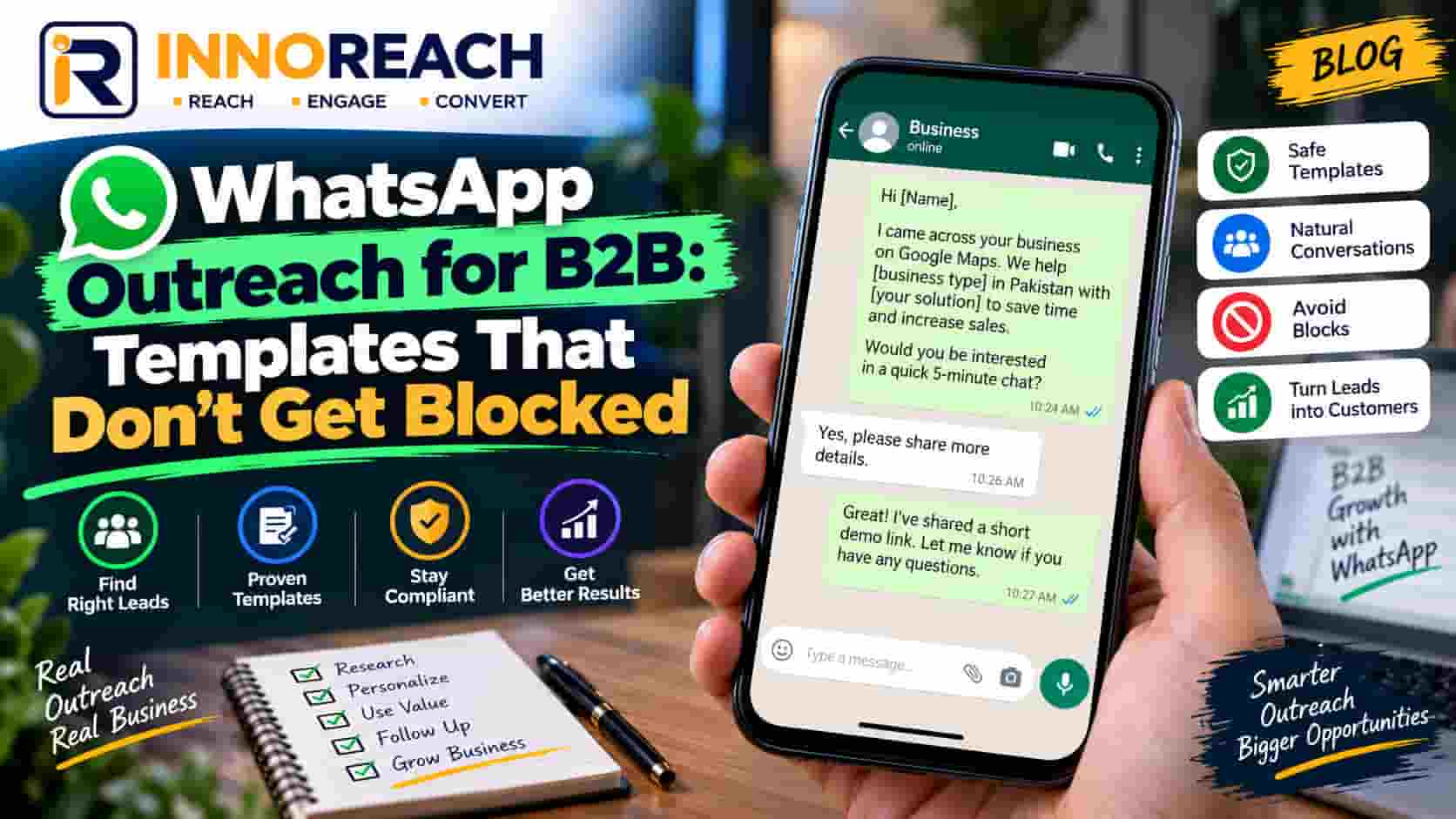
Nearly every B2B deal we close in Pakistan passes through WhatsApp. Not email, not a portal, not a form. The call opens it, WhatsApp carries it, and the money moves on Easypaisa, JazzCash or a bank transfer.
Which is exactly why people ruin it. A number that dials 200 businesses a day is doing normal sales. A number that messages 200 businesses a day that have never heard of it gets reported, restricted, and is worth nothing to anyone.
This is how to use the channel without losing the number.
Why WhatsApp is the default B2B channel here
A shopkeeper in Faisalabad, a clinic manager in Multan, a factory purchase officer in Sialkot — all three read WhatsApp within the hour and none of them reliably read email. Many small businesses do not have a monitored email address at all; the one on the website goes to an account nobody has opened since it was set up.
WhatsApp also carries what these conversations actually need. A photo of the work you did for a similar shop. A voice note in Urdu when typing would take too long. A PDF quotation. A location pin so the rep finds the place. And it keeps the whole thread in one place, so when you call three weeks later the other person can scroll up and remember who you are.
The catch is that it is a personal channel. The same inbox holds their family. That is why an unwanted business message feels more intrusive on WhatsApp than the same message by email, and why the tolerance for it is much lower.
The one rule that prevents blocks
Call first, or have some other real context, before you message.
That is the whole rule. Everything else in this article is detail.
A cold WhatsApp message to a business that has never heard of you asks a stranger to receive a sales pitch in the same app as their children's school group. Some will ignore it. Some will block. A few will report it. WhatsApp does not need many reports against a number before it starts restricting it, and once that happens the number is degraded for everything, including the customers who do want to hear from you.
A call costs thirty seconds and changes the message from unsolicited to expected. Most calls in this market end with "WhatsApp par bhej dein" anyway — send it on WhatsApp — which is explicit permission, given out loud, seconds before you send. That is the context you want on every message you write.
Other forms of earned context that work: they messaged your business number first; they filled a form; they gave you a card at a shop; a mutual contact introduced you. What does not count as context: their number was on their Google listing. A published number means customers may call about their business, not that strangers may pitch them.
If you are building the calling list, the cold calling script guide covers the thirty-second opener that earns you the right to send anything at all.
Anatomy of a message that gets read
Five rules, and they are the same five every time.
- Their name, and their business name. "Ahmed sahib" and "Al-Shifa Pharmacy" prove this is not a broadcast. Nothing else in the message does that job.
- One line saying where you know each other from. "Abhi baat hui thi" — we just spoke. Without it, the reader spends their attention working out who you are instead of reading the offer.
- One link. Not five. Five links looks like spam to a person and to a filter.
- A real price, or a real number. "Starting at PKR 25,000" outperforms "affordable packages" every single time. Vagueness reads as a trap.
- Under five lines. It is being read one-handed behind a counter with a customer waiting.
And what kills a message: "Dear Sir/Madam", a PDF brochure as the opening move, an image sent before any text, a wall of unbroken paragraph, and no name anywhere.
Six templates
Each in English and Romanised Urdu. Change the names, keep the shape.
1. Post-call follow-up
Sent while you are still on the phone, or within ten minutes.
English:
Assalam-o-alaikum Ahmed sahib, Ali here from Innobrains — we just spoke about a website for Al-Shifa Pharmacy. Here is one we built for a pharmacy in Faisalabad: [link] Starting at PKR 25,000, ready in about a week. Any questions, just message.
Romanised Urdu:
Assalam-o-alaikum Ahmed sahib, Ali baat kar raha tha Innobrains se — abhi Al-Shifa Pharmacy ki website ke baare mein baat hui thi. Yeh ek example hai jo humne Faisalabad ki ek pharmacy ke liye banayi: [link] PKR 25,000 se shuru, taqreeban ek hafte mein ready. Koi sawal ho to batayein.
2. Re-engagement after silence
For a lead that went quiet after a first conversation. Give a reason to be messaging today.
English:
Assalam-o-alaikum Ahmed sahib, We spoke last month about the pharmacy website. I have just finished one for a chemist in Madina Town — thought you might want to see how it turned out: [link] Still happy to do yours whenever it suits. Should I call this week or is it not the right time?
Romanised Urdu:
Assalam-o-alaikum Ahmed sahib, Pichle mahine pharmacy ki website ke baare mein baat hui thi. Abhi Madina Town ki ek chemist shop ke liye complete ki hai — socha aap ko dikha doon: [link] Jab aap kahein hum aap ki bhi bana dein. Is hafte call karoon ya abhi waqt theek nahi?
The last line matters. Ask a question that can be answered with one word, and give them an easy way to say no. A lead who says "abhi nahi" is worth more than a lead who says nothing, because now you can set a date.
3. Quote or price message
English:
Assalam-o-alaikum Ahmed sahib, As discussed, here is the quotation for Al-Shifa Pharmacy: 5-page website, WhatsApp button, Google Maps location, 1 year hosting — PKR 32,000, delivered in 7 to 10 days. 50% advance to start. Easypaisa, JazzCash or bank transfer, whichever suits. Shall I begin?
Romanised Urdu:
Assalam-o-alaikum Ahmed sahib, Jaisa baat hui thi, Al-Shifa Pharmacy ke liye quotation: 5 page website, WhatsApp button, Google Maps location, 1 saal hosting — PKR 32,000, 7 se 10 din mein. Shuru karne ke liye 50% advance. Easypaisa, JazzCash ya bank transfer, jo aap ko theek lage. Shuru kar doon?
Payment methods in the message removes a whole round trip. Ending on a direct question is what turns a quote into a decision instead of a document.
4. Appointment confirmation
Send the evening before. It halves your wasted trips.
English:
Assalam-o-alaikum Ahmed sahib, Confirming tomorrow (Thursday) at 11am at your shop, as agreed. Ali from Innobrains. If the timing has changed, just let me know and I will come whenever suits you.
Romanised Urdu:
Assalam-o-alaikum Ahmed sahib, Kal (jumeraat) subah 11 baje aap ki dukan par aana tay hua tha — confirm kar raha hoon. Ali, Innobrains se. Agar waqt badal gaya hai to bata dijiye, main jab aap kahein aa jaunga.
5. Field visit — "I am nearby"
For reps working a beat. Sent when the rep is genuinely in the area, not as a fiction.
English:
Assalam-o-alaikum Ahmed sahib, Ali from Innobrains. I am in Madina Town this afternoon visiting a few shops — can I stop by yours for five minutes, around 3pm? If today is busy, no problem, tell me a better day.
Romanised Urdu:
Assalam-o-alaikum Ahmed sahib, Ali, Innobrains se. Aaj dopahar Madina Town mein hoon, kuch dukanon par jaana hai — aap ke paas paanch minute ke liye aa jaoon, 3 baje ke qareeb? Aaj rush hai to koi baat nahi, kisi aur din bata dijiye.
Only send this when it is true. A rep who is not actually nearby gets caught, and the relationship does not survive it. Reps working from a mapped territory list in the Android app can see which prospects sit on today's route, so the message stays honest and the visit stays on the way.
6. The polite final touch
After three or four touches with no answer, close it out. This message earns you more replies than any of the chasing ones.
English:
Assalam-o-alaikum Ahmed sahib, I do not want to keep messaging you, so this is my last one. If a website is ever useful for the pharmacy, my number is saved here — just message any time. Best wishes for the business.
Romanised Urdu:
Assalam-o-alaikum Ahmed sahib, Baar baar message nahi karna chahta, is liye yeh aakhri hai. Agar kabhi pharmacy ke liye website ki zaroorat ho to mera number yahin hai — jab marzi message kar dijiye. Allah aap ka karobar barhaye.
Then stop, and mark them dead. The whole cadence, call and message together, is in the follow-up cadence guide.
What actually gets you blocked
In rough order of how much damage each one does:
| Behaviour | Why it triggers reports |
|---|---|
| Messaging numbers that have never heard of you | The reader has no reason not to report — they gain nothing by tolerating you |
| Identical text to many people | Recognisable as a broadcast the moment two recipients compare, and easy to pattern-match |
| Image or PDF as the first message | Reads exactly like a spam campaign; also unopened by most people |
| No name, yours or theirs | "Dear Sir" tells the reader this was never meant for them specifically |
| Sending at night or very early | The intrusion is the offence, regardless of the content |
| Repeating after no reply, four, five, six times | Turns indifference into irritation, and irritation into a report |
| Using an unofficial bulk-sending tool | Breaches WhatsApp's terms and is the fastest route to a restricted number |
Notice that only one of those is about volume. What gets a number restricted is people reporting it, and people report messages that feel like they were sent to a list rather than to them.
Business hours and prayer-time etiquette
Send between roughly 10am and 1pm, and 3pm to 7pm, on working days. Nothing before 9am — shopkeepers are opening up and staff are settling. Nothing after 9pm.
Fridays, leave the window from about 12:30 to 2:30 alone for Jumma. Around the daily prayer times, a short pause costs you nothing and a message arriving mid-namaz is remembered badly. During Ramadan the whole rhythm shifts: mid-morning is good, the hour before iftar is not, and late evening after taraweeh is better than it would be in a normal month.
None of this is superstition about deliverability. It is that a message read at a bad moment is judged by the moment, and your goal is a reader who is mildly glad to hear from you.
Volume is not the strategy
Two things bound this properly, and both are worth understanding before anyone scales anything.
WhatsApp's own terms of service prohibit bulk, automated and unsolicited messaging. Breaching them risks the number regardless of what any local law says. Separately, PECA 2016 governs unsolicited electronic communication in Pakistan, which is the legal side of the same behaviour. We are not lawyers and this is not legal advice — if you are planning outreach at any real scale, have someone qualified look at your process.
The practical reading is straightforward. This channel works because of earned context, not volume. One hundred messages to people who spoke to you yesterday will outperform two thousand to strangers, and the two thousand will cost you the number.
So the sequence stays the same: build a qualified list, call it, and message the people who asked you to. If you need the list, the free trial includes 25 leads — enough to make twenty-five real calls and see how many of them ask for WhatsApp. Start there.
Frequently asked questions
Not as a blast, and this is the single most important line in this article. Messaging a large set of numbers that have no idea who you are is what gets a number reported and restricted, and it also breaches WhatsApp's own terms on bulk unsolicited messaging. The workable sequence is call first, then message the ones who agreed to receive something. The list is for dialling, not for broadcasting.
There is no published threshold, and anyone quoting one is guessing — WhatsApp weighs reports and block rates, not just volume. What we can say from our own use is that a rep sending 30 to 60 individually written messages a day to people they have already spoken to has no trouble, while a few dozen identical messages to strangers can attract restrictions within hours. Reports matter more than count.
WhatsApp Business, for anything commercial. It gives you a business profile with your address and hours, labels for organising chats, quick replies for the messages you send twenty times a day, and an away message. It is free and it takes ten minutes to set up. It does not give you permission to bulk message.
Roughly 10am to 1pm and 3pm to 7pm on working days. Avoid before 9am, after 9pm, Friday between about 12:30 and 2:30 for Jumma prayers, and the daily prayer windows. A message that arrives at 11pm is read as intrusive even when the content is fine, and intrusive is exactly what precedes a block.
Unsolicited electronic communication is governed by PECA 2016, and WhatsApp's own terms of service separately restrict bulk and automated unsolicited messaging. Practically that means identify yourself honestly, contact businesses about business, and stop immediately when someone asks you to. This is not legal advice — if you are running outreach at scale, have a qualified lawyer look at it.
You can appeal inside the app, and first-time restrictions are sometimes lifted. Do not buy a new SIM and continue the same behaviour — the pattern is what triggered it, and the second number goes faster than the first. Fix the sequence: call before you message, write each message to one person, and stop messaging anyone who did not reply twice.
Arshad Ali
Innobrains Technologies — we build InnoReach, and we sell with it too.
Keep reading

Lead Follow-Up Cadence: The 4-Touch Template
A four-touch follow-up schedule built for business owners who never open email — call on day 0, WhatsApp on day 3, call again on day 10, one last message on day 30, then let go.
08 Sep 2026 · 11 min
Cold Calling Scripts for Pakistani Businesses (Urdu + English)
Openers in Romanised Urdu and English for shops, clinics, schools and factories, the five objections you will actually hear, and the WhatsApp message to send when they ask for details.
08 Sep 2026 · 9 min
How to Find Businesses Without a Website in Any City
No website is the cleanest qualifying signal in local B2B — it is visible on the listing, it is not a guess, and it writes your opening line for you. Here is how to filter for it properly.
23 Sep 2026 · 9 min