How to Find Businesses Without a Website in Any City
No website is the cleanest qualifying signal in local B2B — it is visible on the listing, it is not a guess, and it writes your opening line for you. Here is how to filter for it properly.
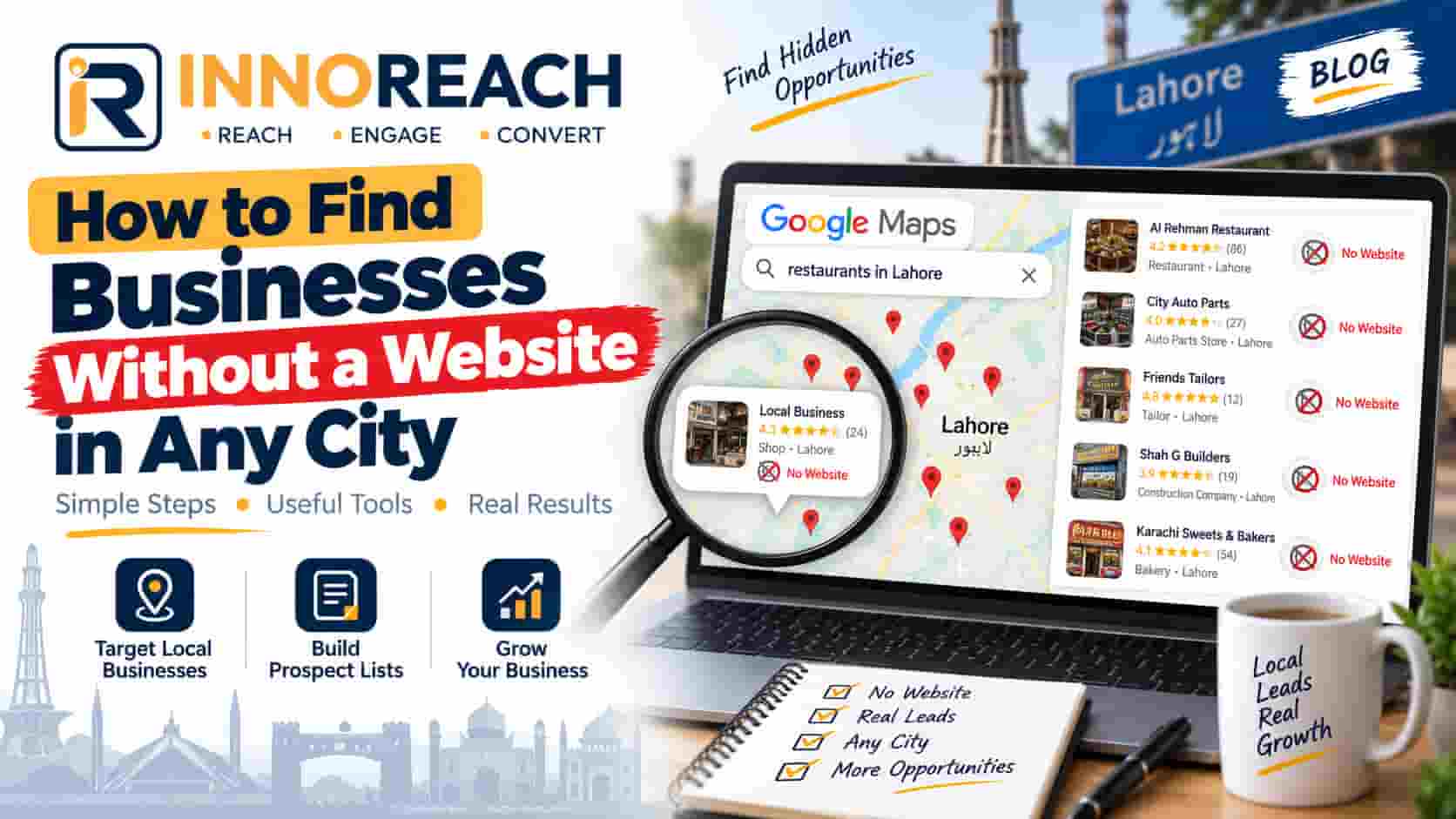
If you sell websites, Google Business setup, or digital marketing to small businesses, you spend most of your effort on one question: who needs this?
There is a field on a Google Maps listing that answers it directly. Either the business has a website or it does not, and it is right there on the page. No inference, no guessing, no buying a signal from a data vendor.
That is the cleanest qualifying signal in local B2B, and most people selling into this market do not use it.
Why "no website" is the best signal you can get
A qualifying signal has to do three things: be reliable, be visible before you make contact, and imply what to say. Most signals manage one.
"Small business" is not observable and does not imply anything. "Growing company" is a guess. "Recently funded" is not a category that exists for a tailoring shop in Sialkot. But no website is factual, checkable in a second, and it hands you the entire opening line.
Compare the two calls:
"Hello, we are a web design company, we build websites for businesses."
"Assalam-o-alaikum. Aap ki shop Google par hai lekin website nahi hai — main isi baare mein baat karna chahta tha."
The first is a pitch anyone could make to anyone. The second proves you looked at their specific business before you rang, and it identifies a gap they can picture in about two seconds. Same product, entirely different call. The cold calling script guide has the full opener and the objections that follow.
It also does something quieter that matters: it tells you who not to call. A business with a polished site, 3,000 reviews and an active blog is not buying a basic website from a stranger on the phone. Filtering them out costs nothing and saves a rep hours a week.
How to filter for it
The website field on a Maps listing is binary in practice — a URL is shown or the field is not there at all. So the filtering itself is trivial. Getting the listings into a form where you can filter them is the work.
You cannot do it inside Google Maps. There is no "hide businesses with websites" toggle and no export button; Maps is built for someone looking for a plumber, not for someone building a list. So the sequence is:
- Run a narrow search — one category, one area. Not "shops in Lahore".
- Collect the listings into a structured list, either by hand or with a browser extension.
- Sort or filter on the website column and keep the blanks.
- Cross-reference with review count to sort the blanks by how well the business is doing.
Step four is the one people skip and it is where the money is. A list of every no-website shop in an area is useful. That same list sorted so the shops with 200 reviews sit at the top is a call sheet.
The InnoReach extension collects the website field along with name, phone, address, category, rating and review count, so the filter is a sort in the lead list afterwards. The full field breakdown is in what data you get.
One expectation to set before anyone spends money: these leads will never have email addresses. Google Maps publishes no emails; emails come from the business website, and these businesses have no website. That is not a limitation of any particular tool, it is arithmetic. These are phone and WhatsApp leads. In this market that is the stronger channel regardless, but if your entire sales process runs on email, this segment is not for you.
Which categories skew offline
The following are our own observations from running searches across Pakistani cities, not published statistics. Treat them as a starting hypothesis to check in your own city rather than as figures to quote.
Categories where a large share of listings have no website:
| Category | Why they tend not to have one | What they usually do want |
|---|---|---|
| Small retail, kiryana, general stores | Walk-in trade, no online ordering | Google listing tidied, photos, WhatsApp catalogue |
| Auto workshops, mechanics, denting-painting | Trade runs entirely on reputation and location | Being findable, reviews, a simple page |
| Tailors, boutiques, embroidery | Instagram or Facebook is the whole shopfront | A page they own, with a portfolio |
| Small clinics, dentists, physiotherapists | Practice fills through referral | Appointments, credibility, timings visible |
| Tuition centres and academies | Word of mouth and banners | Admissions-season pages, fee structure, photos |
| Small traders and wholesalers | B2B relationships, no consumer-facing need | Catalogue, product list, price sheet |
| Beauty salons and barbers | Local, walk-in | Booking, photos, price list |
Categories that are mostly online already, again from our own runs:
- Hotels and guest houses — booking platforms force them online
- Restaurants and cafés in Lahore, Karachi and Islamabad — food delivery aggregators did this
- IT companies, software houses, marketing agencies — a website is their product
- Banks, insurance, larger corporate services
- Franchised anything
The interesting middle: restaurants outside the big three cities, private schools, and pharmacies. In our runs those split roughly down the middle, which makes them worth searching because the half without websites are surrounded by competitors who have one — an argument that writes itself.
Do not take our table on faith. Run one area search in your own city and count the blanks. Fifteen minutes, and you will know your actual market rather than ours.
Working an area at a time
Google caps how deep any single results list goes — roughly 100 to 200 businesses for a city-wide query, no matter how many exist. So "tailors in Lahore" gives you a couple of hundred and stops, and you will never know what you missed.
The fix is not a better tool. It is more searches, each narrower.
Take a city and list its areas the way people who live there describe them. For Faisalabad: Madina Town, Peoples Colony, Ghulam Muhammad Abad, Samanabad, Jhang Bazaar, Susan Road, Batala Colony. For Lahore: Johar Town, Model Town, Gulberg, DHA, Iqbal Town, Township, Shadman. Then run your category against each one.
Twelve to twenty area searches will properly cover a mid-sized city for one category. Two useful notes:
Run keyword variants. "Tailor", "tailoring shop" and "boutique" return overlapping but different sets. So do "clinic" and "medical centre", and "auto workshop" and "car repair". Run all of them; deduplication on the Google place ID collapses the overlap, and duplicates are never charged, so the extra searches cost nothing but time. Searches themselves are free — you are only charged when a genuinely new business enters your account.
Re-run quarterly. New businesses open constantly, and a shop that opened last month has neither a website nor an existing supplier relationship. On a re-run you only pay for what is actually new.
The pitch that works, and the one that fails
The failing pitch is the one that tells the owner they are behind.
"Aaj kal har business ki website hoti hai, aap ki nahi hai — aap bohat pechay reh rahe hain."
Nobody buys after being told they have been doing it wrong. It puts them in a position where agreeing with you means admitting a mistake, so they disagree instead, and the call ends.
The working pitch names something concrete that is happening now.
"Aap ki shop Google par hai — 4.5 rating hai, kaafi acha. Bas ek cheez hai: jab koi aap ka naam search karta hai to sirf address aur phone number aata hai. Photos, rates, products kuch nahi. Hum ek simple si website bana dete hain jis par yeh sab ho — PKR 25,000 se shuru."
Four things are working there. You led with something good about them, so nobody is defending anything. You named a specific, picturable gap — the searcher who found only an address. You gave a price without being asked, which in this market is what separates a real offer from a fishing expedition. And it is short enough to say while the person is serving a customer.
The Facebook page objection
You will hear this constantly, and it is where a lot of reps lose the call.
"Humari Facebook page hai."
For many small businesses that page genuinely is their online presence, and it may be doing real work — customers message it, they post photos, orders come through. Telling them "that's not a real website" is factually arguable and commercially fatal. They hear it as being told their judgement is poor.
Agree, then add:
"Bilkul, page achi hai — maine dekhi thi. Website us ki jagah nahi leti, us ke saath chalti hai. Faraq sirf itna hai ke Facebook page tab dikhti hai jab log Facebook par hon. Website tab aati hai jab koi Google par aap ka naam ya 'best tailor Johar Town' search karta hai — aur woh customer abhi kisi aur ke paas ja raha hai."
Same for a business that has a Google Business profile and nothing else. That is a genuine asset. Compliment it, then offer to add to it. If you sell to agencies' clients, how web agencies find clients in Pakistan goes deeper into positioning this.
Sizing the opportunity in one city
Rough arithmetic, so you know whether this is worth a week of your time. Numbers below are illustrative shape, not measurements.
Take one mid-sized city and one category. Say tailoring and boutique shops across fifteen areas. Suppose the area searches return around 900 listings once duplicates collapse, and suppose 60 per cent have no website — that is 540 prospects. Of those, maybe 200 have enough reviews to suggest real trade, and those are the ones you call first.
Two hundred calls, at a realistic one interested conversation per ten to fifteen connected calls, is somewhere in the region of 15 to 20 real conversations. If a handful convert at PKR 25,000 to 35,000, one category in one city has paid for a lot of months.
Then you have fourteen more categories in the same city, and every other city in the country, and the whole thing re-runs quarterly for the new openings.
The honest caveat: the calling is the hard part, not the list. Building 540 qualified prospects is a couple of days' work. Getting through 200 calls without losing heart on day two is the actual job, and no tool changes that.
If you want to see what your own city looks like before committing anything, the free trial includes 25 leads — enough for one area search in one category, to count how many blanks come back. Start there, or read the complete guide to Google Maps lead generation for the full process from search to closed deal.
Frequently asked questions
The website field on a listing is either present or absent, so once the listings are in a list you filter for rows where it is empty. You cannot do this inside Google Maps itself, which has no such filter and no export. The practical route is to collect the listings for one area and category, then sort by the website column and work the blanks.
It varies enormously by category and city, so a single figure would be misleading. In our own runs across Pakistani cities, small retail, workshops and tailoring shops are heavily weighted toward no website, while hotels and city-centre restaurants mostly have one. Run one area search in your own category and count — that number is worth more than any published average.
Many will, and they often consider that as having an online presence. Do not open by telling them they are wrong. The workable line acknowledges the page and adds to it — a website they own, that appears when someone searches their name on Google, and that is not dependent on a platform's reach. Contradicting someone in the first ten seconds of a cold call ends the call.
Sometimes, and sometimes the opposite. A shop with a 4.6 rating and 300 reviews and no website is doing well without one, which means they can afford it and they have a reputation worth showing. Cross-reference no website with review count before you judge budget — the busiest offline businesses are usually the best prospects, not the worst.
No, and this is worth being blunt about. Google Maps publishes no email addresses at all — emails come from the business website, so a listing with no website has no source for one. Any vendor promising emails for these leads is pattern-guessing. These leads are phone and WhatsApp leads, which in this market is the better channel anyway.
Arshad Ali
Innobrains Technologies — we build InnoReach, and we sell with it too.
Keep reading
How to Build a Retailer List for a Distributor
Your order book shows who buys from you. It cannot show who does not. Here is how to map every retail outlet in a territory, calculate the coverage gap, and route a rep's day around it.
16 Sep 2026 · 9 min
B2B Lead Generation in Pakistan: Channels That Actually Work
Why imported B2B playbooks fail in Pakistan, an honest assessment of every channel from Maps outbound to biradari referrals, and how to pick two instead of trying eight.
11 Sep 2026 · 15 min
How to Find Clients for a Web Development Agency in Pakistan
A working method for small agencies and freelancers — finding local businesses with no website, a realistic daily call quota, what to charge in PKR, and a worked month of numbers.
10 Sep 2026 · 12 min