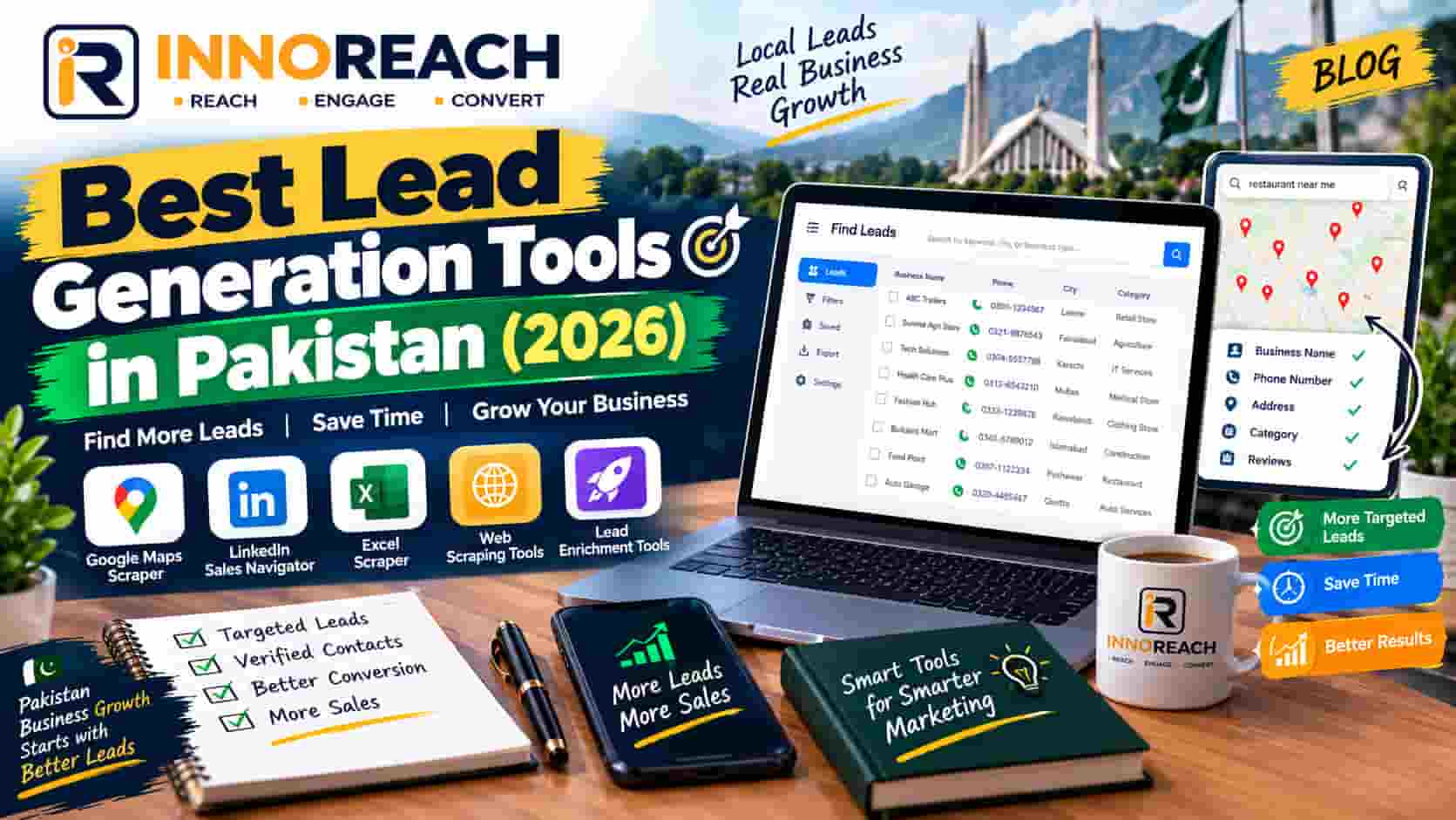
Best Lead Generation Tools in Pakistan (2026)
Lead generation tools that actually work for Pakistani businesses, organised by what you sell and who you sell to — local B2B, corporate B2B, recruiting and e-commerce, with honest notes on cost and coverage.
Most "best lead generation tools" lists are written for a buyer in Austin or Manchester, and it shows. They rank tools by feature count, assume a company credit card, and assume every prospect has a LinkedIn profile and a company domain.
Pakistan is a different market. A large share of the businesses worth selling to here have no website, no LinkedIn presence and no filed accounts. They have a shop, a phone number, and a Google Maps listing.
So this list is organised by who you are selling to, not by rank. A tool that is perfect for one of these use cases is useless for another, and calling any of them "the best" without that context is not helpful.
One disclosure up front: we make one of the tools on this list. We have tried to be straight about where the others beat us, and there is a note at the end about why we listed them at all.
Use case 1: Local B2B — selling to shops, clinics, schools and traders
This is the largest untapped segment in Pakistan and the one international tools serve worst.
If you sell websites, POS systems, accounting software, insurance, packaging, wholesale supply, cleaning services, signage or almost any B2B service to small local businesses, your prospects are pharmacies in Faisalabad, tuition centres in Gujranwala, auto parts traders in Karachi and private clinics in Islamabad. None of them are in a global B2B database. All of them are on Google Maps, because they wanted walk-in customers.
Google Maps outbound (InnoReach)
A Chrome extension collects the listings from a Maps search — name, phone, address, category, website, rating, review count, opening hours — and the leads land in a lead CRM where the calls get made and logged.
Who it suits. Small sales teams doing local outbound by phone, WhatsApp or field visit. Team accounts give each rep a licence with credits pooled at the organisation level, and there is an offline Android app with GPS punch-in for reps doing shop-to-shop rounds where signal is unreliable. Credits are 1 per new unique business, deduplicated on Google place ID so repeat searches only charge for genuinely new listings. Searches are free. Priced in PKR, paid by bank transfer, Easypaisa or JazzCash. Free trial is 25 leads.
Where it falls short, honestly. Google Maps holds no email addresses — emails are read from the business website afterwards, and in our own runs across Pakistani cities only a fifth to a third of listings yield one. Google also caps a single search at roughly 100 to 200 results, so a city needs several neighbourhood searches rather than one big one. And the Chrome extension installs in developer mode rather than from the Chrome Web Store at present, which is a couple of extra steps. This is a B2B-only channel; if you sell to consumers, nothing here helps.
More on who uses it and how in who uses InnoReach, and the full method in our guide to Google Maps lead generation.
Physical directories and trade associations
Chamber of commerce member lists, market association registers, trade body directories, the printed directories that still circulate in wholesale markets.
Who it suits. Anyone selling into a specific trade — textile, pharma, auto parts, surgical goods in Sialkot. These lists are often better qualified than anything digital, because membership itself is a signal of size and seriousness.
Where it falls short. Manual entry, no export, frequently out of date, and no way to know which entries you have already worked. Worth using once for a target trade, not as a repeatable system.
Facebook groups and marketplace
Trade groups, city business groups, buy-and-sell groups. Free, and genuinely active in Pakistan in a way they are not in some markets.
Who it suits. Early-stage businesses with more time than money, and anyone whose buyers congregate in a specific group. Also good for research — you learn how people in a trade talk about their problems.
Where it falls short. No structure, no export, no way to tell a serious buyer from a browser, and group admins will remove you fast if you post like an advertisement. It is a channel, not a database.
Use case 2: Corporate B2B — selling to larger companies
Different buyer, different tools entirely.
If you sell enterprise software, consultancy, recruitment services or corporate training, your buyer is a manager at a bank, a telco, a large manufacturer, a multinational or a big NGO. That person is on LinkedIn, has a work email on a company domain, and is exactly who international tools were built for.
LinkedIn Sales Navigator
Search and filter LinkedIn profiles by company, seniority, function and geography, then reach people through InMail or connection requests.
Who it suits. Anyone selling to corporate decision-makers in Karachi, Lahore or Islamabad. For that buyer it is the strongest tool available and nothing local competes.
Where it falls short in Pakistan. It bills in USD by card, monthly, which is real friction for a small local firm. Coverage of Pakistani SMEs is thin — the owner of a 12-person trading company is usually not on LinkedIn, and if he is, he does not check it. And it gives you a person, not a phone number, so your outreach is limited to the channels LinkedIn allows.
Apollo and similar B2B contact databases
Contact databases combining company and person records with email addresses, sold as credit packs or seat subscriptions billed monthly in USD.
Who it suits. Teams doing email-led outbound to companies with real domains and formal structures, especially if some of your market is outside Pakistan.
Where it falls short in Pakistan. Coverage is the problem. These databases are built by crawling company websites, LinkedIn and public filings, and Pakistani SMEs generate almost none of that exhaust. Run a search for small businesses in Gujranwala and see what comes back. Add USD-only billing and the picture is clear: excellent tools, aimed at a market segment that is a small slice of Pakistan's business population.
There is more on matching channel to buyer in our piece on B2B lead generation in Pakistan.
Use case 3: Recruiting — finding candidates rather than customers
Worth separating out, because recruiters keep landing on sales tools that do not fit.
Rozee.pk
The established local job board, with a CV database employers can search.
Who it suits. Almost any Pakistani employer hiring locally. Volume of local candidates is its whole advantage, and no international platform matches it here.
Where it falls short. Skews towards candidates actively looking. For senior or specialist hires who are employed and not searching, you will not find them there.
LinkedIn (recruiter search)
Who it suits. Senior, technical and corporate hires — developers, finance staff, managers at established firms.
Where it falls short. Same limits as above: billed in USD, and coverage thins out fast below the corporate tier. A production supervisor at a Faisalabad textile mill is unlikely to have a profile.
Google Maps, for recruiters selling to employers
The often-missed one. A recruitment agency's customers are companies, and companies are on Maps. Searching a city for a category — private schools, hospitals, software houses, factories — gives you the employers to pitch, which is the recruiter's actual sales problem. Candidates come from Rozee; clients come from outbound.
Use case 4: E-commerce and seller lists
If you sell to online sellers — logistics, packaging, photography, store setup, ad management — your prospects are visible in a few places.
Daraz seller pages
Every Daraz store has a public page with a shop name, ratings and product range. That tells you who is selling, in what category, and roughly at what scale.
Who it suits. Anyone whose service is aimed at active online sellers. The rating and product count give you a size signal before you make contact.
Where it falls short. No phone numbers and no export. You get a name and a category, then you go looking for contact details elsewhere — often by searching that business name on Google Maps, which closes the loop.
OLX
Business sellers advertise on OLX with contact numbers attached, and many are small traders you will not find in any database.
Who it suits. Sellers of services to small traders, especially in used goods, vehicles, property and electronics.
Where it falls short. Heavily mixed with individual consumers, no way to filter for businesses reliably, and no export. Useful for spot research, not for building a list.
The verdict table
Ratings below are our own judgement based on working this market, not a benchmark study.
| Tool | Best for | Pakistan coverage | PKR / local payment | Who it suits |
|---|---|---|---|---|
| InnoReach | Local B2B outbound from Maps | Strong for any listed business | Yes — bank transfer, Easypaisa, JazzCash | Small sales teams calling and visiting |
| Physical directories | Trade-specific lists | Good but patchy and dated | Free or membership fee | Anyone targeting one trade |
| Facebook groups | Research, early outreach | Strong, unstructured | Free | Early-stage, time-rich businesses |
| LinkedIn Sales Navigator | Corporate decision-makers | Good at corporate tier, thin for SMEs | No — USD card | Enterprise and B2B services sellers |
| Apollo-type databases | Email-led corporate outbound | Weak for Pakistani SMEs | No — USD card | Teams selling to firms with real domains |
| Rozee.pk | Local candidate sourcing | Strong | Yes | Employers and recruiters hiring locally |
| Daraz seller pages | Finding active online sellers | Good within e-commerce | Free to browse | Services aimed at online sellers |
| OLX | Small traders with numbers listed | Broad but noisy | Free to browse | Sellers to small traders |
A note on the fact that we make one of these
We build InnoReach, and it is on this list. That is worth saying plainly rather than burying.
We have listed the others fairly for a straightforward reason: the alternatives are better than us for several of these use cases, and pretending otherwise would be found out in about a week. If you are selling enterprise software to bank executives, Sales Navigator will beat us and we have nothing that competes. If you are hiring a warehouse manager, Rozee is the answer. If your buyers are in a Facebook trade group you already belong to, that is free and it works.
What we are good at is one thing: local B2B outbound to businesses that exist on Google Maps and nowhere else, for a team that needs to call them and remember what was said. That is a narrow claim, and it is the only one we are making.
How to choose in five minutes
- Write down who your buyer is — a person at a large company, or the owner of a small local business. Everything follows from this.
- Ask where they are already listed. Corporate buyer, LinkedIn. Local business, Google Maps. Online seller, Daraz.
- Check you can actually pay. A tool you cannot buy without an international card is not an option, however good it is.
- Test on a small batch before buying volume. Fifty leads called properly tells you more than five thousand sitting in a file.
- Decide where the leads will live. A list with no pipeline behind it stops being worked within a fortnight, regardless of which tool produced it.
If your buyers are local businesses, the free trial gives you 25 leads — enough for one real search on your own city and category. Start free, or see what the plans cost.
Frequently asked questions
It depends entirely on who you sell to. For local B2B — shops, clinics, schools, traders — Google Maps outbound is the strongest channel, because those businesses are on Maps and in no corporate database. For selling to large corporates, LinkedIn Sales Navigator or Apollo work better, though both bill in USD and their coverage of Pakistani SMEs is thin.
Two reasons. Their databases are built around companies with LinkedIn profiles, registered domains and filed accounts, and most Pakistani SMEs have none of those. And they bill in USD by card, which is real friction here. A tool can be excellent and still be the wrong one for a Faisalabad textile trader.
Very few international ones, which is why local buyers often end up borrowing a card or paying an agent a markup. InnoReach is priced in PKR and takes bank transfer, Easypaisa or JazzCash. If local payment matters to you, it is worth checking before you invest time in a trial.
Yes, if your buyers are managers at banks, telcos, large manufacturers, multinationals or big NGOs — those people are on LinkedIn and reachable. No, if you sell to shops, clinics or small traders. That owner is probably not on LinkedIn at all, and if they are, they do not check it.
Less than people expect at first. Fix the calling process on a small batch before buying volume — if you cannot convert 100 leads, 10,000 will not save you. Most small teams we see spend meaningfully less on tools than on the salary of the person making the calls, and that ratio is the right way round.
Yes, for what they are. Facebook groups, physical directories and trade association lists cost nothing but your time and often surface businesses that no tool has. They do not scale, and they give you no deduplication or follow-up tracking, so treat them as a supplement rather than a system.
Arshad Ali
Innobrains Technologies — we build InnoReach, and we sell with it too.
Keep reading
Google Maps Scraper With a Built-In CRM
Most lead-gen effort dies in the handoff between the export and the phone call. A buyer's guide to scraper plus CRM, scraper plus spreadsheet, and one tool doing both.
21 Sep 2026 · 9 min
InnoReach vs Apify for Google Maps Scraping
Apify is a developer platform, InnoReach is a sales tool. The real question is whether you have a developer, and what happens to the data after the run finishes.
20 Sep 2026 · 8 min
InnoReach vs Outscraper: Which Fits Your Sales Team?
One is an extraction service, the other is a sales workspace. An honest comparison including where Outscraper is clearly the stronger product and you should buy that instead.
19 Sep 2026 · 8 min