B2B Lead Generation in Pakistan: Channels That Actually Work
Why imported B2B playbooks fail in Pakistan, an honest assessment of every channel from Maps outbound to biradari referrals, and how to pick two instead of trying eight.
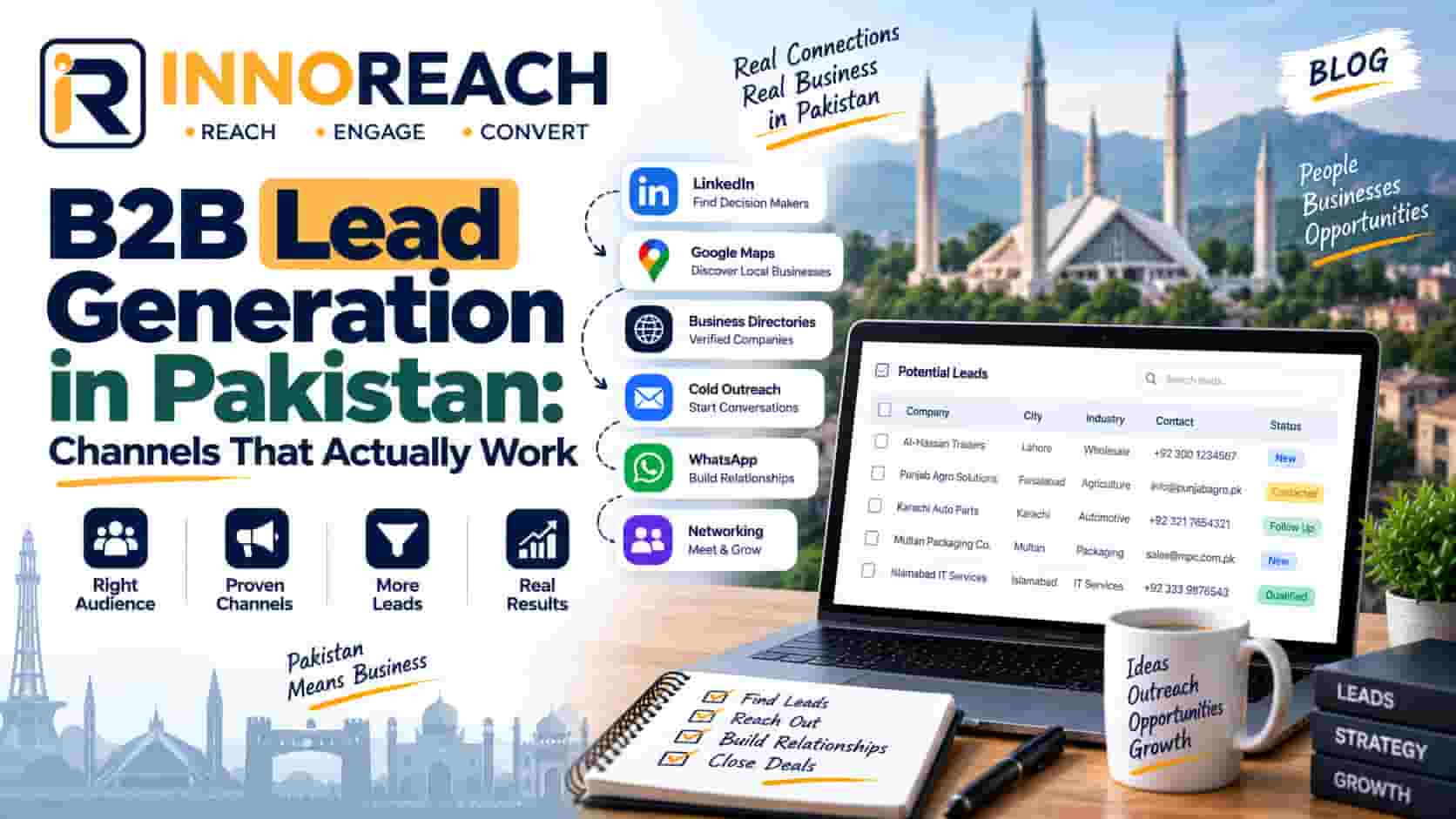
Most B2B lead generation advice you will read was written for a market where companies have monitored email addresses, a national business register anyone can query, and buyers who research on LinkedIn before speaking to a salesperson.
Pakistan is not that market. Applying that playbook here produces a lot of activity and very few customers, and it is why so many small businesses conclude that lead generation does not work when what failed was an imported method.
This is an honest assessment of the channels that are actually available here, what each costs, how fast each produces anything, and who each suits. Some of them we sell into. We will say which, and we will say where other channels beat us.
Why the imported playbooks fail here
Four structural differences, and every one of them breaks a standard tactic.
Email is not the business channel. In most of the world, a cold email lands in an inbox somebody opens. In Pakistan, the owner of a pharmacy, a workshop, a school or a trading company frequently has no business email at all, or has one that was set up years ago and is never checked. Even where an address exists, the decision-maker is not the person reading it. Building a strategy on email here means building on an address that nobody opens.
It gets worse when you try to source those addresses. Google Maps publishes no email field whatsoever. Any tool that gives you emails from Maps data got them by visiting the business website afterwards, which means a business with no website will never yield one. In our own runs across Pakistani cities, somewhere between a fifth and a third of listings produce an email at all. Phone numbers, by contrast, are present on the large majority. That ratio should decide your channel strategy on its own.
There is no usable company database. SECP filings cover registered companies, which excludes most of the economy. Chamber directories are partial and often years out of date. The international B2B data vendors are built around LinkedIn profiles and company domains, so their Pakistan coverage collapses to a few hundred large firms. The three-person trading company in Karachi doing PKR 40 million a year appears in none of them.
LinkedIn is thin outside a narrow slice. It genuinely works for corporate head offices, banks, telecoms, IT and software houses, recruitment, and export-facing businesses. Outside that, the people who run Pakistani businesses are simply not there. Advice to "build your LinkedIn pipeline" is good advice given to the wrong country for most sellers here.
Business runs on WhatsApp and the phone. Quotes, orders, negotiations, catalogues and payment confirmations all move through WhatsApp. A stranger phoning a business is normal and not resented, provided the call is short and has a reason. Any strategy that avoids the phone is avoiding the main road.
Channel by channel
Google Maps outbound
Search Maps by category and area, collect the listings, qualify them, call them.
This is the only channel that gives you a list of small Pakistani businesses that is both broad and current, and the reason is who maintains it: the owner updates their own listing because customers use it to call them. A bought list decays from the day it was compiled. A Maps listing is corrected by the person who cares most about it being right.
You get business name, phone, full address, self-chosen category, website if there is one, star rating, review count and opening hours. That is enough to know who they are, roughly how big they are, how well regarded they are, and how to reach them.
The honest limits, because they shape what is possible. Google caps a single search at roughly 100 to 200 results no matter how many businesses exist, so you cannot get every pharmacy in Lahore from one query — the way past it is more searches split by neighbourhood and narrower category, not a better tool. There are no emails. There is no decision-maker name; you get the business, not the person. And categories are noisy because businesses choose their own.
Cost: low, and predictable. With InnoReach one credit is one new unique business saved, searches themselves are free, and deduplication on Google place ID means a business already in your account is never charged again — so re-running a search next month costs only for the new openings. Plans are in PKR, payable by bank transfer, Easypaisa or JazzCash. The Chrome extension needs no developer and loads in developer mode in a couple of minutes; see the install guide.
Speed: you can have 300 qualified leads by this afternoon and interested conversations by tomorrow.
Suits: web agencies, software vendors, distributors, insurance, equipment suppliers, recruiters, anyone selling to local businesses. Useless if you sell to consumers, since Maps lists businesses and no tool changes that. The full method is in the complete guide.
WhatsApp Business
Not really a prospecting channel. It is the conversion channel, and it is where nearly every B2B deal in this country is actually negotiated.
Roughly every second cold call here ends with WhatsApp par details bhej dein. That is not a brush-off — it is how business is done. The catalogue feature, quick replies and labels are genuinely useful for a small sales operation.
The failure mode is treating it as a broadcast tool. Bulk messages to purchased number lists get your number blocked quickly, annoy people who might otherwise have bought, and under PECA the part that creates real legal exposure is continuing after someone has told you to stop. A personal message referencing a conversation you actually had is a different thing entirely and works very well.
Cost: effectively free. Speed: immediate. Suits: everyone, as the second touch after a call rather than the first touch on its own.
Cold calling
Still the highest-yield outbound channel in Pakistan, for the simple reason that the number on a Maps listing is there precisely so it rings, and someone answers it.
What matters is not delivery, it is the list. With a qualified list and a specific opening observation about that particular business, expect roughly one interested conversation per ten to fifteen connected calls, and a meeting or firm quote request from perhaps a third of those. With an unqualified list and a generic pitch it is several times worse. The list carries more weight than the script.
A sustainable quota for one person who also delivers work is 30 to 40 dials a day, of which about 20 connect. Best windows are roughly 11am to 1pm and 4pm to 6pm, avoiding the first hour after opening, prayer times and Friday afternoons.
Cost: your time, plus airtime. Speed: same day. Suits: almost every B2B seller here. Openers in Urdu and English, the five objections you will actually hear, and the WhatsApp follow-up are in the cold calling scripts guide.
Worth being precise rather than dismissive. LinkedIn works well in Pakistan for a defined set:
- Corporate head offices, banks, telecoms, large FMCG
- IT companies, software houses, and anyone selling to them
- Recruitment and staffing, where it is arguably the primary channel
- Export businesses and anyone selling to foreign buyers
- Enterprise software with long sales cycles and committee decisions
Outside that set it is close to useless, and the reason is arithmetic: the people who run the majority of Pakistani businesses do not have profiles, or have a dormant one from a job they left in 2016. Sales Navigator is an expensive USD subscription that does not create members who are not there.
Cost: free to moderate; Sales Navigator is billed in USD, which is its own friction here. Speed: slow, weeks to months. Suits: IT, recruitment, corporate and export sellers only.
Facebook groups and Marketplace
Pakistani business, trade and city groups have real members and occasionally real buyers. But most groups selling services are saturated with sellers pitching sellers, and a genuine requirement post draws forty comments within minutes.
Where it works better is niche trade groups — a specific industry, a specific market, a specific city's traders. There, being consistently helpful for a few months builds recognition. Posting your service list does not.
Cost: free, plus a lot of time. Speed: slow and unpredictable. Suits: businesses with a genuinely niche vertical and patience.
Referrals and biradari networks
The strongest channel in Pakistan and the one nobody can scale on demand.
Trust here travels through family, community and trade networks. A recommendation from someone in the same biradari, the same market association, or the same mosque carries more weight than anything you can say about yourself. Deals close in one meeting that would take five cold meetings otherwise.
The problem is volume. Referrals arrive when they arrive, and a business dependent on them has revenue that looks like a heart monitor. The fix is not to abandon the channel but to feed it deliberately: retained clients you speak to monthly refer you; clients you delivered to eighteen months ago and never contacted again do not remember your name.
Cost: free, but slow to build. Speed: unpredictable, sometimes years. Suits: everyone, as a compounding second channel — never as the only one.
Trade associations and chambers
The Faisalabad, Lahore, Karachi and Gujranwala chambers, plus sector bodies like APTMA, PPMA and the various traders' associations, hold real concentrations of buyers in one place.
Membership gets you directories, events and a degree of credibility that opens doors. The directories vary enormously in quality — some are current, some list numbers that stopped working in 2019. Events convert well because the people there came to do business, but attendance is a time cost and results build over quarters.
Cost: membership fees, typically low tens of thousands of PKR a year depending on the body, plus event time. Speed: slow, months. Suits: manufacturers, exporters, industrial suppliers and anyone selling into a defined sector.
Physical market visits
Underrated, and in some sectors unbeatable. Walk into Hafeez Centre, a wholesale cloth market, an industrial estate, or the auto parts bazaar and speak to owners face to face.
Conversion per conversation is far higher than any remote channel, because you are a person standing in front of them rather than an unknown number. It is also the slowest possible use of a day if it is unplanned — a rep with leads scattered across a whole city spends the day in traffic.
The way to make it work is to plan routes from a qualified list: all the leads in one market, in one visit, in address order. The Android app is built for this specific job — the lead list works offline, which matters when the signal in a wholesale market is one bar, numbers are already normalised so a tap dials or opens WhatsApp, notes are logged on the spot, and field visits can be punched in with GPS so a shop visited on Tuesday is recorded as visited on Tuesday rather than argued about on Friday.
Cost: travel and a lot of time. Speed: immediate per conversation, low volume. Suits: distributors, equipment and hardware sellers, anyone with reps and a defined territory.
Paid ads
Meta and Google ads generate inbound leads, and inbound leads are pleasant because the buyer contacted you.
The difficulty is cost and quality. Ad costs have risen steadily for Pakistani advertisers, and for B2B the targeting is blunt — you cannot reliably target "owns a pharmacy in Faisalabad and has no website" on Meta, so you pay to show your ad to a great many people who are not that. Lead-form leads in particular arrive in volume and convert poorly, and someone still has to call every one of them.
This is precisely why a lot of Pakistani SMBs have shifted budget from ads back to outbound. If PKR 40,000 a month in ad spend produces twenty weak leads, and the same money spent on a lead subscription plus one person's calling time produces three hundred qualified ones you contact directly, the arithmetic is not close for most small sellers. Ads make more sense once you have a high-value offer with a proven conversion rate to defend the cost per lead.
Cost: high and rising. Speed: fast to start, slow to make profitable. Suits: established businesses with tested offers and margin to absorb learning.
Rating the channels
Honest scores, based on what we see working for the businesses we sell to.
| Channel | Cost | Speed | Volume you control | Best for |
|---|---|---|---|---|
| Google Maps outbound | Low | Fast | High | Anyone selling to local businesses |
| Cold calling | Low | Fast | High | Almost all B2B here |
| WhatsApp Business | Very low | Immediate | Medium | Follow-up and conversion, not prospecting |
| Physical market visits | Medium | Medium | Low | Distributors, equipment, field teams |
| Referrals and biradari | Free | Slow | None | Everyone, as a second channel |
| Trade associations | Medium | Slow | Low | Manufacturers, exporters, sector sellers |
| Medium | Slow | Medium | IT, corporate, recruitment, export only | |
| Facebook groups | Free | Slow | Low | Niche verticals with patience |
| Paid ads | High | Medium | Medium | Proven offers with margin |
| Cold email | Low | Slow | Low | Corporate and export only |
The pattern is not subtle. The channels where you control the volume — outbound calling on a list you built — are also the cheapest and fastest. The channels that convert best per conversation, referrals and face-to-face, are the ones you cannot turn up on demand.
Pick two channels, not eight
The most common mistake is running everything at once. A small team tries LinkedIn, Facebook, ads, cold email, calling and networking simultaneously, does all of them at about 20% effort, gets weak results from each, and cannot tell which one deserved more.
Pick two, on this basis:
One volume channel you control. For nearly every B2B seller in Pakistan that is Maps-sourced calling. You decide how many businesses you contact today, which means results are a function of effort rather than luck.
One compounding channel. Referrals fed deliberately through retained clients, or a chamber membership you actually attend, or a niche trade group where you are genuinely useful. These pay off in month six, not month one, which is exactly why they need starting in month one.
Then leave the rest alone for six months. If you sell to IT companies or do recruitment, swap the volume channel for LinkedIn — that is the one clear exception.
Measure the right four numbers
Most small businesses measure nothing, then argue from impressions. Four numbers settle every argument:
- Leads collected — how many qualified businesses entered the pipeline.
- Connected conversations — not dials. Conversations with a human.
- Interested — someone who asked a real question or requested a quote.
- Closed, and the revenue.
Track them per channel and per month. Within two months the picture is obvious: one channel produces most of the interested conversations and the others produce activity.
The practical requirement is that every lead carries a status, a call log and a next-touch date. A lead with no next date is one you have already lost and not yet noticed, and most B2B deals in Pakistan die of silence rather than rejection — the owner said WhatsApp par bhej dein, you sent it, and nobody went back. The four-touch cadence is the fix: call on day 0, WhatsApp on day 3, call on day 10, one last message on day 30, then mark dead.
Twenty leads fit in your head. Two hundred do not, and two hundred is a normal month. The lead CRM exists for that gap — leads arrive from a search already in the pipeline, every call and note stays attached to the business, and the morning starts with a due-today list. If you run reps, organisation and team accounts hold credits in one pool with a licence per rep, so every call is attributed to whoever made it and the owner sees the whole pipeline rather than six private spreadsheets. Who uses it shows how different trades arrange this.
Where the legal line sits
Two separate questions, and conflating them causes most of the confusion.
Collecting publicly published business contact details is generally lawful. It is the same act as writing them down by hand from a page you were already allowed to look at.
Contacting people is where the rules live, and they apply to you as the sender. In Pakistan, PECA 2016 governs unsolicited electronic communication. In practice: identify yourself honestly, contact businesses about business, keep a record of anyone who asks you to stop, and actually stop. If you are contacting buyers in the EU or the US, GDPR and CAN-SPAM add their own requirements. Our FAQ covers the questions we get asked most. None of this is legal advice; if you are running large-scale outreach into the EU, get someone qualified to look at it.
Start narrow
Do not build a strategy. Pick one category, one city, one qualifying signal, and one channel, and work it for a month.
Concretely: search one category in one area of your city, qualify the list hard, call thirty a day, follow the four-touch cadence, and log every outcome. Count the four numbers at the end of the month. Then either double down or change the category based on what the numbers say rather than on how the calls felt.
The free trial includes 25 leads, which is enough to see what your own market actually looks like before spending anything. Start there, or look at what the plans cost in PKR. If you want the full outbound method end to end, the complete guide to Google Maps lead generation is the place to start.
Frequently asked questions
Rarely, outside corporate, IT and export-facing companies. Most SMB owners do not have an email address anyone monitors, and Google Maps holds no emails at all, so lists are thin to begin with. In our own runs only a fifth to a third of listings yield any email. Calling and WhatsApp reach the same people far more reliably.
Only in specific segments. Corporate head offices, banks, telecoms, IT and software houses, recruitment and export businesses are genuinely reachable there. The pharmacy, the auto workshop, the tuition centre, the fabric wholesaler and most of the SMB economy are not on it in any usable way, and no amount of Sales Navigator changes that.
There is no reliable national company database with working phone numbers. Google Maps is the closest thing, because the owners maintain their own listings so customers can find them, and it covers small businesses that no commercial database has ever recorded. Chamber and association directories are useful for specific sectors but are often out of date.
Two. One outbound channel you control the volume of, such as Maps-sourced calling, and one compounding channel such as referrals or content. Running eight channels badly produces less than running two properly, and it makes it impossible to tell which one is working.
Messaging a business number published publicly is normal practice here and is how most B2B conversations continue after a call. Keep it personal rather than broadcast, identify yourself honestly, and stop when someone asks. Under PECA, continuing after a request to stop is the part that creates real trouble, and mass broadcast also risks the number being blocked.
The first interested conversations come within days of starting to call. Closed deals typically take three to six weeks, because the four-touch follow-up cadence runs over about a month. The compounding shows in month two and three, when leads from month one that were not ready start coming back.
Arshad Ali
Innobrains Technologies — we build InnoReach, and we sell with it too.
Keep reading

How to Find Businesses Without a Website in Any City
No website is the cleanest qualifying signal in local B2B — it is visible on the listing, it is not a guess, and it writes your opening line for you. Here is how to filter for it properly.
23 Sep 2026 · 9 min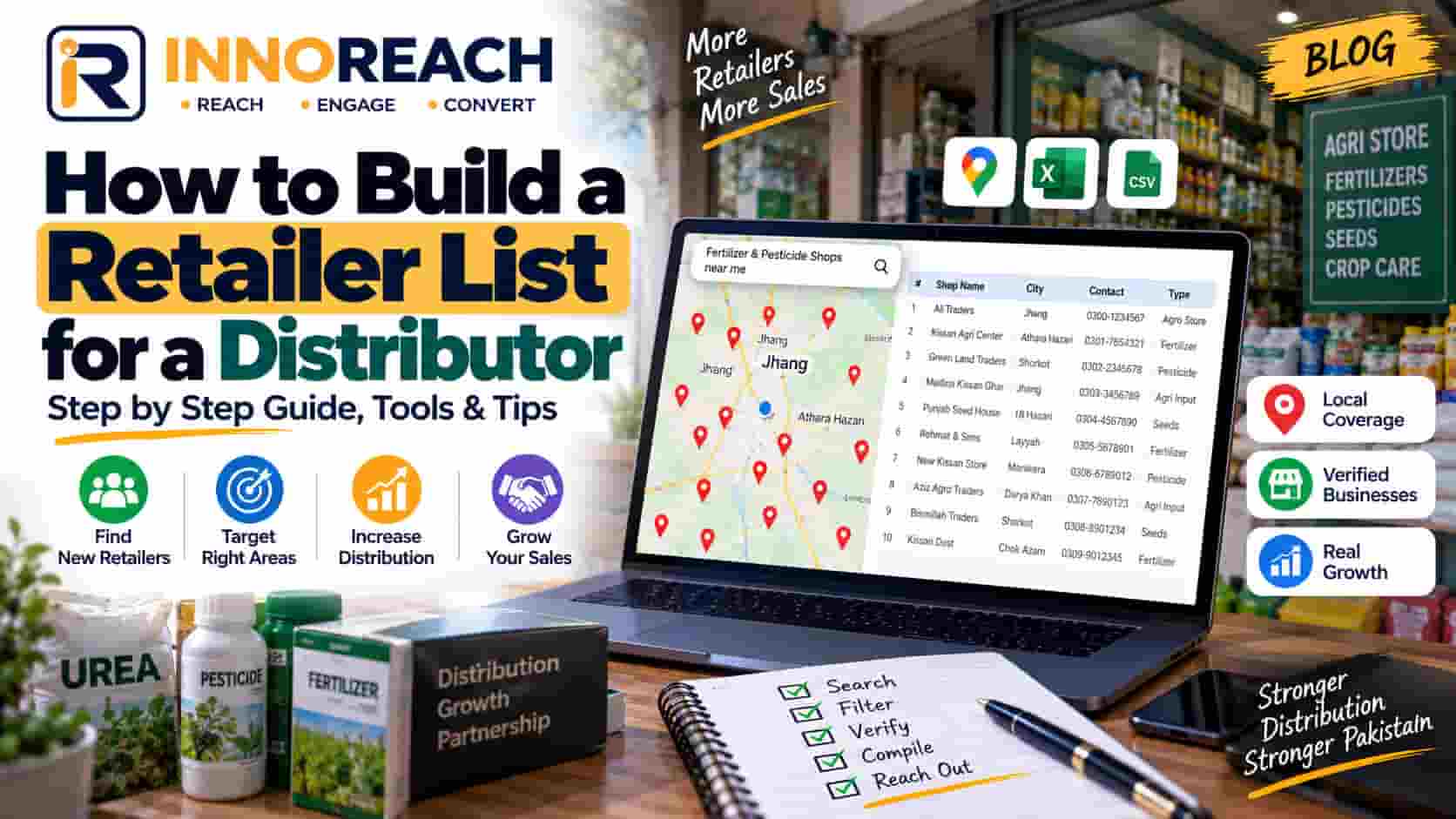
How to Build a Retailer List for a Distributor
Your order book shows who buys from you. It cannot show who does not. Here is how to map every retail outlet in a territory, calculate the coverage gap, and route a rep's day around it.
16 Sep 2026 · 9 min
How to Find Clients for a Web Development Agency in Pakistan
A working method for small agencies and freelancers — finding local businesses with no website, a realistic daily call quota, what to charge in PKR, and a worked month of numbers.
10 Sep 2026 · 12 min