How to Build a Retailer List for a Distributor
Your order book shows who buys from you. It cannot show who does not. Here is how to map every retail outlet in a territory, calculate the coverage gap, and route a rep's day around it.
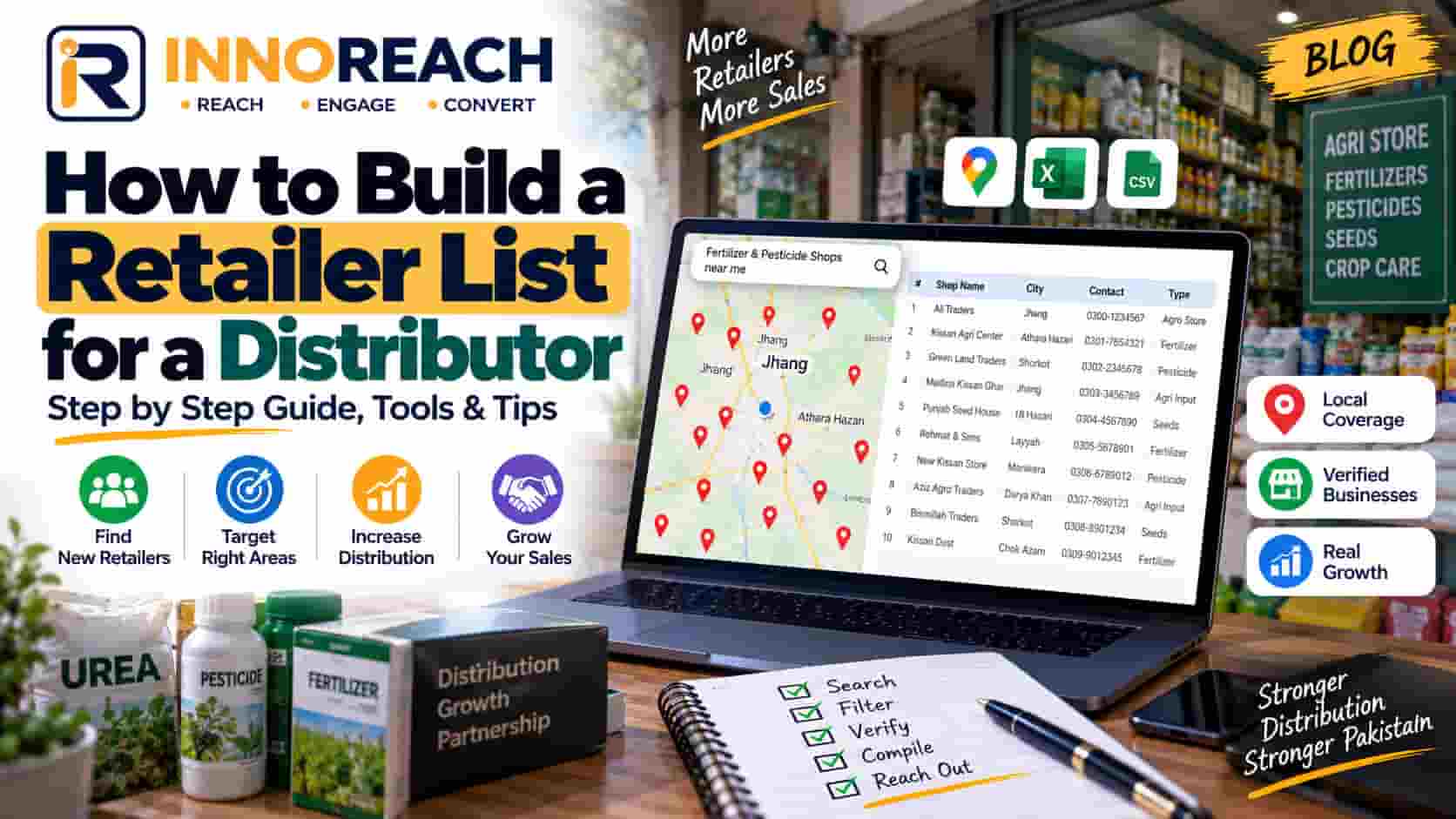
Every distributor we have worked with can tell you their monthly sales figure to the rupee. Almost none of them can tell you how many shops in their territory sell their category and do not buy from them.
That second number is the business.
Why distributors run blind
A distributor's order book is a record of success. It lists the outlets that already buy. Every report generated from it — top parties, slow movers, area-wise sales, rep performance — is built on the same population: your existing customers.
The problem is what the order book physically cannot contain. It has no row for the general store two streets from your best account that has been buying from a competitor for four years. It has no row for the pharmacy that opened in March. It has no row for the shop that stopped ordering in June and that nobody noticed, because a stopped order looks like nothing at all in a ledger.
So the distributor's view of the territory is exactly as large as their current coverage. If you supply 130 shops in a town, your data describes 130 shops. Whether the town has 200 or 700 is a question the order book is structurally unable to answer.
This is not a software failure. Every ERP and accounting system behaves the same way, because they are built to record transactions and a shop that never bought from you never generated one. The gap has to be filled from outside.
Building the territory map, area by area
Google Maps has these outlets because the shops put themselves there to get walk-in customers. What you want out of it is not a lead list in the sales sense — it is a census of the territory.
The technique is the opposite of what people try first. Do not search "general store in Faisalabad". You will get roughly 100 to 200 results and stop, because Google caps how deep any single results list goes regardless of how many businesses exist.
For a distributor, that cap is genuinely useful. It forces you to search in territory-sized chunks, which is the unit your reps work in anyway.
So instead:
- General stores in Ghulam Muhammad Abad
- General stores in Madina Town
- General stores in Peoples Colony
- General stores in Samanabad
- General stores in Jhang Bazaar
Each of those returns a manageable set, well under the cap, and each maps to a beat a rep can walk. Twelve to twenty area searches will cover a mid-sized city properly. Run them once, then re-run them quarterly to catch new openings — the InnoReach extension fingerprints each business on its Google place ID, so a re-run only charges for outlets that were not already in your account. Duplicates from overlapping area searches are never charged either, which matters when neighbourhood boundaries blur.
Expect the base map to be incomplete. Shops inside a covered wholesale market, very old outlets that never bothered with a listing, and businesses trading purely on relationships will be missing. In our own runs across Punjab cities, a Maps-built list finds most of a retail category and misses a visible minority. Your reps fill those in during the first month of visits, which is fine — a map at 85 per cent coverage that you can correct beats a blank page.
Categorising by outlet type
A raw list of 480 businesses is not a coverage plan. Before it becomes one, sort it by outlet type, because the outlet type determines order size, visit frequency and who you send.
For FMCG in a typical Pakistani city the split usually looks something like this:
| Outlet type | What Maps calls it | Typical visit frequency | Who visits |
|---|---|---|---|
| Kiryana / general store | Grocery store, general store, convenience store | Weekly | Order booker |
| Superstore / mart | Supermarket, department store | Weekly, sometimes twice | Senior rep |
| Wholesaler | Wholesale market, distributor | Fortnightly | Owner or manager |
| Tuck shop, canteen | Convenience store, snack bar | Fortnightly | Order booker |
| Pharmacy, for OTC lines | Pharmacy, chemist | Weekly | Separate beat |
Two practical notes. Google categories are chosen by the business itself, so they are noisy — a listing calling itself a supermarket might be four hundred square feet. And one keyword misses outlets: "kiryana store", "general store" and "grocery store" return overlapping but different sets, so run all three and let the place-ID dedup collapse them into one list.
The fields you actually get — name, phone, full address, category, rating, review count, website if there is one — are enough to do this sorting before anyone leaves the office. Review count in particular is a rough proxy for footfall, which is a rough proxy for order size.
The coverage gap calculation
This is the number that makes the whole exercise worth doing, and it is arithmetic.
Take one territory. Count the outlets you mapped that sell your category. Count the outlets in that territory currently on your order book. Subtract.
A worked example, with figures rounded:
| Area | Outlets mapped | Currently supplied | Gap | Penetration |
|---|---|---|---|---|
| Madina Town | 118 | 41 | 77 | 35% |
| Ghulam Muhammad Abad | 143 | 28 | 115 | 20% |
| Peoples Colony | 96 | 39 | 57 | 41% |
| Samanabad | 123 | 22 | 101 | 18% |
| Total | 480 | 130 | 350 | 27% |
The matching is the fiddly part. Your ledger has "Al-Madina Store" and the map has "Al Madina General Store", at an address written differently. Match on phone number first — it is the most reliable common field — then on address, then by eye. Budget a day for a first pass over a few hundred outlets. It is tedious and it is done once.
What the table tells you is where to send people. Samanabad and Ghulam Muhammad Abad hold roughly twice the absolute opportunity of Peoples Colony, and no amount of pushing the existing 130 accounts harder would ever have revealed that.
Routing a rep's day geographically
Once the gap list exists, the temptation is to sort it by size — biggest shops first. Resist it. Sort by geography.
A rep with 30 high-value outlets scattered across a city visits perhaps 12, because the rest of the day is spent on a motorbike. A rep with 30 outlets along four adjacent streets visits all 30. Coverage is a travel problem before it is a persuasion problem.
Build the beat as a loop: start at one end of the area, work down one side of the road, come back up the other. Mix existing accounts with gap outlets on the same beat, so the rep is never doing a full day of cold approaches — call at the shops that already order, and knock on the three new doors in between. That is far easier to sustain than a dedicated prospecting day, which reps quietly stop doing after the second week.
Field reps need this list on the phone, not on paper. The Android app holds the assigned list offline, because signal inside a covered market is not something to plan around, and tapping an outlet dials it or opens WhatsApp without anyone retyping a number.
Field visits and GPS punch-in
A visit nobody recorded did not happen, as far as the business is concerned.
The mechanism worth having is a punch-in at the shop: the rep opens the outlet in the app, taps to record the visit, and the app checks the phone is within about 300 metres of the mapped location before it accepts. That gives you a timestamped, located record of presence.
Three honest points about it.
300 metres is deliberate, not sloppy. Phone GPS indoors — and a shop is indoors, often under a metal roof, in a dense market — is routinely 50 to 100 metres out. A 50-metre radius produces constant false rejections, and a rep standing in the correct shop being told they are not there concludes the app is broken and stops using it. A loose radius reps trust beats a tight one they route around.
It proves presence, not a conversation. A punch-in cannot tell you whether the rep spoke to the owner or to the shop boy. Pair it with a required outcome — ordered, no stock need, owner absent, refused — so the record has content in it.
Tell the reps it exists, and why. Punch-in framed as coverage proof for the company is accepted. The same feature discovered by accident is read as surveillance and poisons everything else you are trying to introduce. In our product it is visit-time only — the app is not following a rep between shops — and the admin can switch it off.
Measuring territory penetration monthly
Run the same arithmetic every month. One number per area, one line each.
Samanabad: 123 mapped, 22 supplied in January, 29 in February, 34 in March. 18% to 28%.
That is the report a distributor should be reading, and it is the one almost nobody has. Sales figures go up and down with seasons, price changes and one large party ordering early. Penetration moves only when a rep opened a shop that was not open before.
Three things to watch alongside it:
- New outlets found by reps. These are the ones Maps missed. Adding them keeps the denominator honest — penetration that rises because the map is stale is not real.
- Outlets that stopped ordering. A shop on your supplied list with no order in eight weeks has usually switched to a competitor. It is far cheaper to win back than a shop that never bought at all.
- Per-rep coverage. With an organisation account, each rep works under their own licence against pooled credits, so daily reports and visit records attribute to the person who did them, and private notes stay visible to the owner. That is how you find out one rep's area is flat because they visit 14 shops a day while everyone else visits 30.
The realistic first month
Map two areas, not the whole city. Two hundred to three hundred outlets is enough to do the matching properly and see whether the gap number is believable.
Assign them to one rep, punch-in on, and count what happens. If the gap across two areas is 150 outlets and a rep opens 11 of them in a month, the arithmetic for the rest of the city is straightforward, and so is the case for a second rep. If the gap turns out to be 30, you already have good coverage and should spend the effort on order size instead. Either answer is worth more than the guess you are working from now.
Distributors are one of the trades this suits particularly well; who uses it covers the others and how their qualifying signals differ. The free trial includes 25 leads, enough to map one small area and see whether your ledger matches the street. Start there, or read B2B lead generation in Pakistan for the wider picture.
Frequently asked questions
In dense urban markets — a wholesale bazaar in Faisalabad or Karachi's Jodia Bazaar — a rep can realistically visit 25 to 40 outlets a day, because the shops are metres apart. In spread-out residential areas or small towns it drops to 12 to 20, and most of the difference is travel. Route by area, not by outlet size, or the travel eats the day.
No, and any tool claiming otherwise is guessing. Coverage is strongest for shops that wanted walk-in customers and weakest for outlets inside a covered wholesale market that trade purely on relationships. In our own runs across Punjab cities, a Maps-built list finds most of a retail category and misses a visible minority. Treat it as the base map your reps correct, not a finished census.
It depends entirely on the category and your competition, so any universal number is invented. What matters is the trend in one territory over three months. If you map 480 general stores in a town and supply 130, that is 27 per cent — and the useful question is whether it is 31 per cent next quarter, not whether 27 is good.
A GPS punch-in makes it much harder, because the app only records a visit when the phone is within about 300 metres of the shop's mapped location. It is not proof of a conversation, and it should not be sold to a rep as a lie detector. It is proof of presence, which is the thing a manager genuinely cannot see otherwise.
Split geographically, never alphabetically or by outlet size. Draw the territory into five contiguous areas, assign each rep the outlets inside one, and keep those boundaries stable for at least a quarter so relationships build. An organisation account lets you assign a separate list per rep while credits stay pooled at company level.
Arshad Ali
Innobrains Technologies — we build InnoReach, and we sell with it too.
Keep reading

How to Find Businesses Without a Website in Any City
No website is the cleanest qualifying signal in local B2B — it is visible on the listing, it is not a guess, and it writes your opening line for you. Here is how to filter for it properly.
23 Sep 2026 · 9 min
B2B Lead Generation in Pakistan: Channels That Actually Work
Why imported B2B playbooks fail in Pakistan, an honest assessment of every channel from Maps outbound to biradari referrals, and how to pick two instead of trying eight.
11 Sep 2026 · 15 min
How to Find Clients for a Web Development Agency in Pakistan
A working method for small agencies and freelancers — finding local businesses with no website, a realistic daily call quota, what to charge in PKR, and a worked month of numbers.
10 Sep 2026 · 12 min