How to Find Clients for a Web Development Agency in Pakistan
A working method for small agencies and freelancers — finding local businesses with no website, a realistic daily call quota, what to charge in PKR, and a worked month of numbers.

Every small web agency in Pakistan hits the same wall. The first two or three clients come from people you know. Then that runs out, and there is no obvious next move.
What follows is a method that does have a next move. It is not clever. It is finding businesses that visibly need what you sell, calling them, and following up until they say yes or no. The part that makes it work is that almost nobody else bothers.
Why the usual advice stalls
The advice you get is Upwork, referrals, and Facebook groups. All three do work eventually. None of them works reliably when you need a client this month.
Upwork and Fiverr. A global auction where the buyer sees your price next to a developer in Bangladesh quoting less, and filters by reviews you have not got yet. Getting established takes months of bidding for free. Worth building in the background; not a plan for the rent.
Referrals. Genuinely the best source of clients, and completely uncontrollable. Referrals arrive when they arrive. An agency that depends on them has revenue that looks like a heart monitor. Build the referral engine, but do not confuse it with a pipeline.
Facebook groups. Pakistani business and freelancing groups are full of people offering the same service you are, to an audience of people offering the same service you are. The occasional real buyer posts a requirement and gets forty comments in ninety seconds. You are the fortieth.
Waiting for inbound. SEO on your own agency site is a twelve-month project. Do it, but not instead of something that produces a conversation this week.
The common problem: in all four you are one of many, competing on price or luck, and you have no control over the volume.
Outbound is the opposite. You decide how many businesses you contact today. If you call thirty local businesses that have no website, you are usually the only person who called them about a website this month. That is a much better position than being the fortieth comment.
The no-website search recipe
The whole method rests on one search shape:
Category + city or neighbourhood + no website.
A business that has put itself on Google Maps has already decided it wants to be found by customers. If it has no website, it has that want and no solution. That is as clear a buying signal as this market offers, and it is sitting in public.
Concretely:
- Pharmacies in Ghulam Muhammad Abad, Faisalabad, no website
- Private schools in Gujranwala, no website
- Auto workshops in Model Town, Lahore, no website
- Marble and tile traders in Karachi, no website
- Dental clinics in G-11, Islamabad, no website
Note the neighbourhoods. Google caps a single search at roughly 100 to 200 results however many businesses exist, so "car dealers in Lahore" gives you a couple of hundred and stops. Ten area searches across Lahore give you the actual market. In our experience that single habit is the difference between people who end up with 200 leads and people who end up with 2,000.
Run the search in Google Maps, collect the results with the Chrome extension, and the listings land in your account with name, phone, address, category, rating, review count and website — deduplicated on Google place ID, so re-running the same search next month only charges for businesses that opened since. Setup takes a couple of minutes; the install guide has the steps.
Two honest notes before you build expectations. There are no email addresses on Google Maps, so any email you get comes from crawling the business website, which by definition these no-website leads do not have. That is fine, because you are going to call them anyway, and calling works better here. And categories are self-chosen, so a "general store" might be a supermarket or a kiosk. Expect to discard some. The full field-by-field picture is on what you get.
How to qualify before you dial
A list of every business without a website is not yet a call list. Sort it, and let the sort choose your pitch.
| Signal | What it suggests | How to treat it |
|---|---|---|
| No website, 50+ reviews, rating above 4 | Real volume, well run, can afford it | Call first. Best leads on the list. |
| No website, 10-50 reviews | Established, modest scale | Core of the list. Standard pitch. |
| No website, under 5 reviews, listing looks new | Recently opened | Worth calling — new businesses buy. Budget may be small. |
| No website, rating under 3 | Something is wrong operationally | Lower priority. A site will not fix their problem. |
| Has a website, but it is broken or from 2014 | Already believes in the idea | Excellent lead. Redesign is an easier sell than a first site. |
| Big chain or franchise | Decision is made in a head office elsewhere | Skip. |
Review count is your best proxy for whether they can pay. A business with sixty reviews has customers walking in. A business with two might be three months old and running on savings.
Category matters too. Some verticals buy websites readily — schools and academies, clinics, salons, gyms, property dealers, restaurants. Others rarely do, because their customers are trade buyers who found them decades ago: small wholesalers, scrap dealers, single-machine workshops. You will learn your own market's pattern within two hundred calls. Write it down when you do. Other trades slice this differently, which who uses it covers.
A well-qualified list of 200 outperforms an unsorted list of 2,000 and costs a tenth as much to build.
A realistic daily quota
Here is what one person can actually sustain while also delivering client work.
- 30 to 40 dials a day, in one or two blocks of about an hour each.
- Best windows are roughly 11am to 1pm and 4pm to 6pm. Avoid the first hour after opening, prayer times, and Friday afternoons.
- Of 35 dials, expect around 20 to connect with someone. Wrong numbers, no answers and staff who cannot help account for the rest.
- Of 20 connections, 1 or 2 will be genuinely interested on a well-qualified list. The rest are polite deferrals.
That is roughly 8 interested conversations a week, 30 a month. It does not feel like much on any given afternoon. Over a month it is a pipeline.
The discipline that makes it work is finishing the list. The failure mode for every agency owner is making twelve calls, getting no interest, deciding the method does not work, and going back to bidding on Upwork. The first five calls of any session are uncomfortable and the twelfth is mechanical. Judge the method on 200 calls, not on 12.
The Android app matters if you are dialling from a phone rather than a desk. The list, the last note and tap-to-call sit in one place, numbers are already in international format so WhatsApp opens on a tap, and it works offline.
What to charge
These are typical market ranges that small Pakistani agencies quote, gathered from what clients tell us they have been offered elsewhere. They are not our prices and they are not a recommendation — your city, your portfolio and your delivery cost all move them.
| Deliverable | Typical range (PKR) |
|---|---|
| Single-page or landing site | 15,000 - 25,000 |
| Small brochure site, about 5 pages | 20,000 - 40,000 |
| Business site, custom design, 8-12 pages | 60,000 - 150,000 |
| E-commerce, catalogue and checkout | 150,000 - 400,000+ |
| Google Business Profile setup and optimisation | 5,000 - 15,000 |
| Monthly maintenance, hosting and small edits | 3,000 - 10,000 per month |
| Content or social media retainer | 15,000 - 50,000 per month |
Two rules about price on a cold call.
Say the number. When an owner asks kitna kharcha hoga, answering "it depends on requirements" is the fastest way to lose them. They read it as being set up for a negotiation they will lose. Give a starting figure, say what it includes, ask a question back.
Do not be the cheapest. There is always someone quoting PKR 8,000 and disappearing after the first payment. Owners in Faisalabad and Gujranwala have usually been burned by that person already. Being a real business with an office, examples and a phone number that gets answered is worth more than a discount.
The pitch that works
Everything above exists to make one sentence possible: a specific observation about this business.
"Assalam-o-alaikum. Kya main malik sahib se baat kar raha hoon? Main Ali baat kar raha hoon, Innobrains se, Faisalabad se. Main yahan ke pharmacies dekh raha tha — aap ka pharmacy Google par hai lekin website nahi hai. Aaj kal log pehle online dekhte hain phir aate hain. Hum chhote businesses ke liye simple website banate hain — kya aap ne kabhi socha is baare mein?"
"We do web development" gets you hung up on. "Your pharmacy is on Google but has no website" gets you a reply, because it proves you looked at them specifically.
Then almost every one of these calls ends the same way: WhatsApp par details bhej dein. Send it while you are still on the phone, four lines, their name and business name, two examples, a starting price. And book the next touch before you hang up.
"Ji bilkul, abhi bhejta hoon. Aap ka yehi number hai WhatsApp ka? Parson call kar ke pooch loon ga ke aap ne dekha ya nahi — theek hai?"
The full set of openers by trade, plus the five objections you will actually hear including mera bhatija banata hai, is in the cold calling scripts guide.
A worked month
Numbers from a single person working this part-time alongside delivery. Treat them as a plausible shape rather than a promise — they are our own rough figures and yours will differ by city and category.
| Stage | Number | Notes |
|---|---|---|
| Area searches run | 8 | Two cities, four categories, split by neighbourhood |
| Businesses collected | 620 | After place-ID dedup |
| With no website | 310 | Roughly half, typical for local retail and services |
| Qualified as worth calling | 180 | After removing chains, under-3 ratings, dead listings |
| Dials made | 700 | 35 a day, 20 working days |
| Connected conversations | 400 | Some leads dialled twice as part of the cadence |
| Genuinely interested | 28 | About 7% of connections |
| Quotes sent | 19 | |
| Meetings or shop visits | 9 | |
| Closed | 3 |
Three clients. At a mix of a PKR 35,000 brochure site, a PKR 80,000 business site and a PKR 20,000 Google Business Profile setup, that is PKR 135,000 in the first month, from about forty hours of calling and roughly 620 leads collected.
The number that matters most is not the three. It is the 25 interested-but-not-yet leads still sitting in the pipeline with a next-touch date on them. Those are month two's revenue, and they cost nothing more to collect. This is why the method compounds and why judging it after two weeks tells you nothing.
Keeping 180 live leads straight is not a spreadsheet job. Each needs a status, a call log and a next-touch date, and a lead with no next date is one you have already lost without noticing. That is what the lead CRM is for — leads arrive from the search already in the pipeline, and the morning starts with a due-today list instead of a scroll. The follow-up cadence guide has the day 0, 3, 10 and 30 template these numbers assume.
Why retainers beat one-off builds
Three closed websites in a month is good. It is also the problem with selling websites: next month you start at zero again, having spent the month delivering rather than selling. That cycle is why so many small agencies stay small.
The fix is to convert every build into a monthly relationship. When you hand over the site, hand over an offer with it: hosting, maintenance, small content edits, a Google Business Profile kept current, monthly photos, a stock of new pages as they need them. Somewhere in the PKR 3,000 to 10,000 a month range is easy to say yes to when the client has just paid PKR 60,000 and does not want to think about it again.
The arithmetic is what makes it worth doing. Twenty retained clients at PKR 6,000 a month is PKR 120,000 recurring before a single new sale — which for a two or three person agency in Faisalabad or Gujranwala is most of the fixed cost covered. Once that floor exists, every new build is profit rather than survival, and you can be selective about which clients you take.
Retained clients also produce the referrals that everyone tells you to rely on. Someone you speak to monthly recommends you. Someone you delivered to eighteen months ago does not remember your name.
Start with one category and one area
Do not try all of this at once. Pick one category you can talk about credibly and one area you can visit. Run the search, qualify hard, call thirty a day, follow the four-touch cadence, and log everything.
Count what happens over 200 calls, not 20. Then either double down on that category or change it based on the numbers rather than on how the calls felt.
The free trial includes 25 leads, which is enough to run one real search on your own city and see how many of them actually have no website. Start there, or read the complete guide to Google Maps lead generation for the method end to end. Pricing is in PKR, payable by bank transfer, Easypaisa or JazzCash, and if you have reps rather than working alone, team accounts pool credits across per-rep licences.
Frequently asked questions
Search Google Maps by category and city, then filter for listings with no website in the website field. A business on Maps with no site has already shown it wants to be found and has not solved the problem, which is the clearest buying signal available in this market. Narrow by neighbourhood, because one city-wide search caps out at around 100 to 200 results.
Typical market ranges run from roughly PKR 20,000 to 40,000 for a small brochure site, PKR 60,000 to 150,000 for a business site with more pages and custom design, and PKR 150,000 upwards for e-commerce. These are what small agencies commonly quote, not our prices, and they vary a lot by city and by how established the agency is.
Thirty to forty dials in about two focused hours is a sustainable daily quota for one person who also delivers client work. Around twenty will connect, one or two will be genuinely interested, and the rest go into the follow-up cadence. More than forty a day and quality drops noticeably by the end of the list.
Upwork is a global auction where your main visible difference is price, and buyers filter by reviews you do not have yet. It can work after you have built a profile, but for a new agency it is months of unpaid bidding. Local outbound gets you a paying client faster because you are the only person who called that pharmacy this week.
Sell the website to get in, then move the client onto a monthly maintenance, hosting and content retainer. One-off builds mean starting from zero every month. Even a modest retainer per client, multiplied across twenty clients, covers a small team's fixed costs before any new sales happen.
You need something, because the first thing an interested owner does is check whether you have one. It does not have to be elaborate — who you are, three examples of work with photos, a price starting point, a phone number and a WhatsApp button. Selling websites without having one is a conversation that ends quickly.
Arshad Ali
Innobrains Technologies — we build InnoReach, and we sell with it too.
Keep reading

How to Find Businesses Without a Website in Any City
No website is the cleanest qualifying signal in local B2B — it is visible on the listing, it is not a guess, and it writes your opening line for you. Here is how to filter for it properly.
23 Sep 2026 · 9 min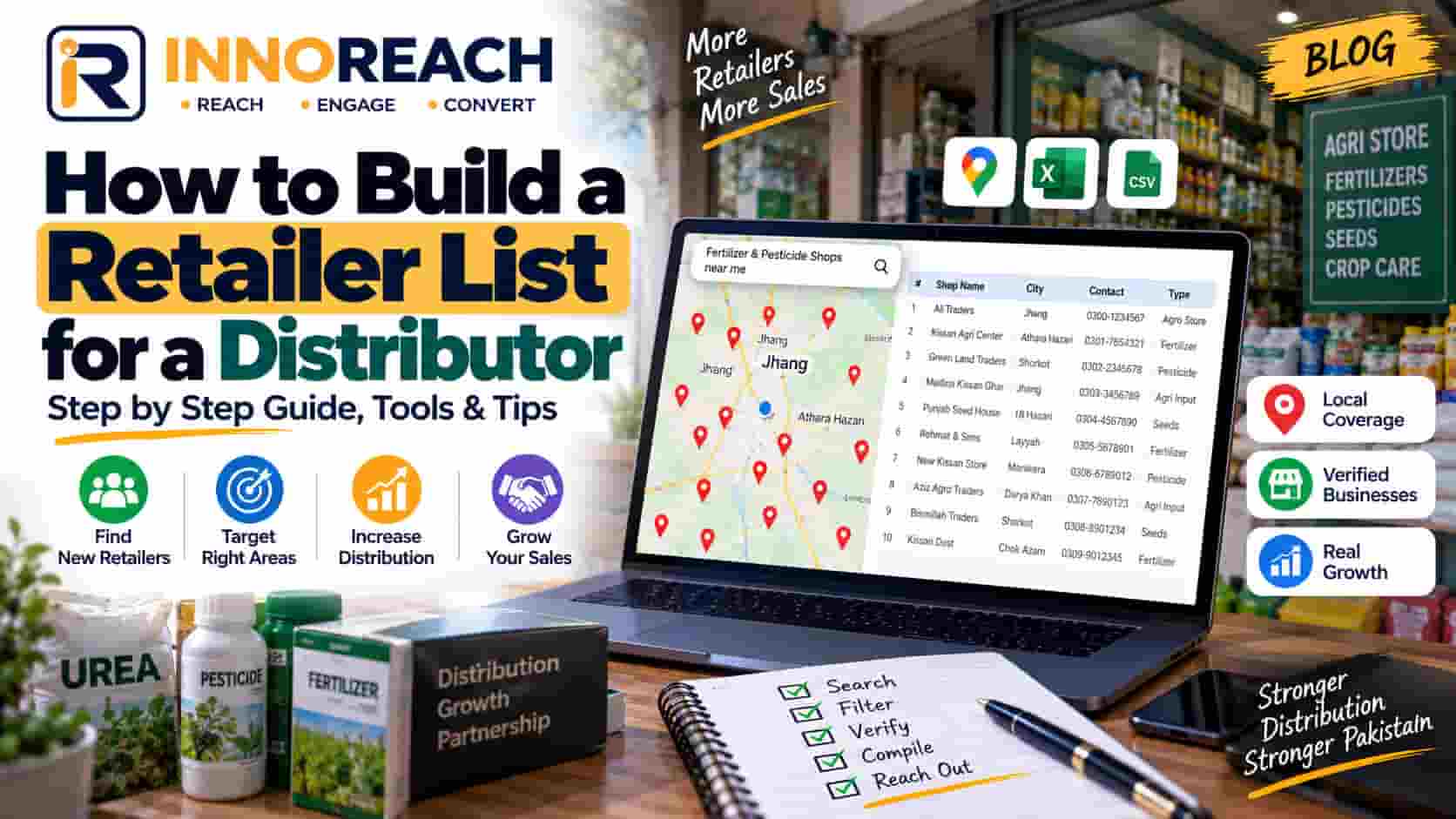
How to Build a Retailer List for a Distributor
Your order book shows who buys from you. It cannot show who does not. Here is how to map every retail outlet in a territory, calculate the coverage gap, and route a rep's day around it.
16 Sep 2026 · 9 min
B2B Lead Generation in Pakistan: Channels That Actually Work
Why imported B2B playbooks fail in Pakistan, an honest assessment of every channel from Maps outbound to biradari referrals, and how to pick two instead of trying eight.
11 Sep 2026 · 15 min