Is Scraping Google Maps Legal? Pakistan, EU and US
Two separate questions get muddled into one — collecting published business data, and contacting people afterwards. Here is how the landscape looks in Pakistan, the EU and the US.
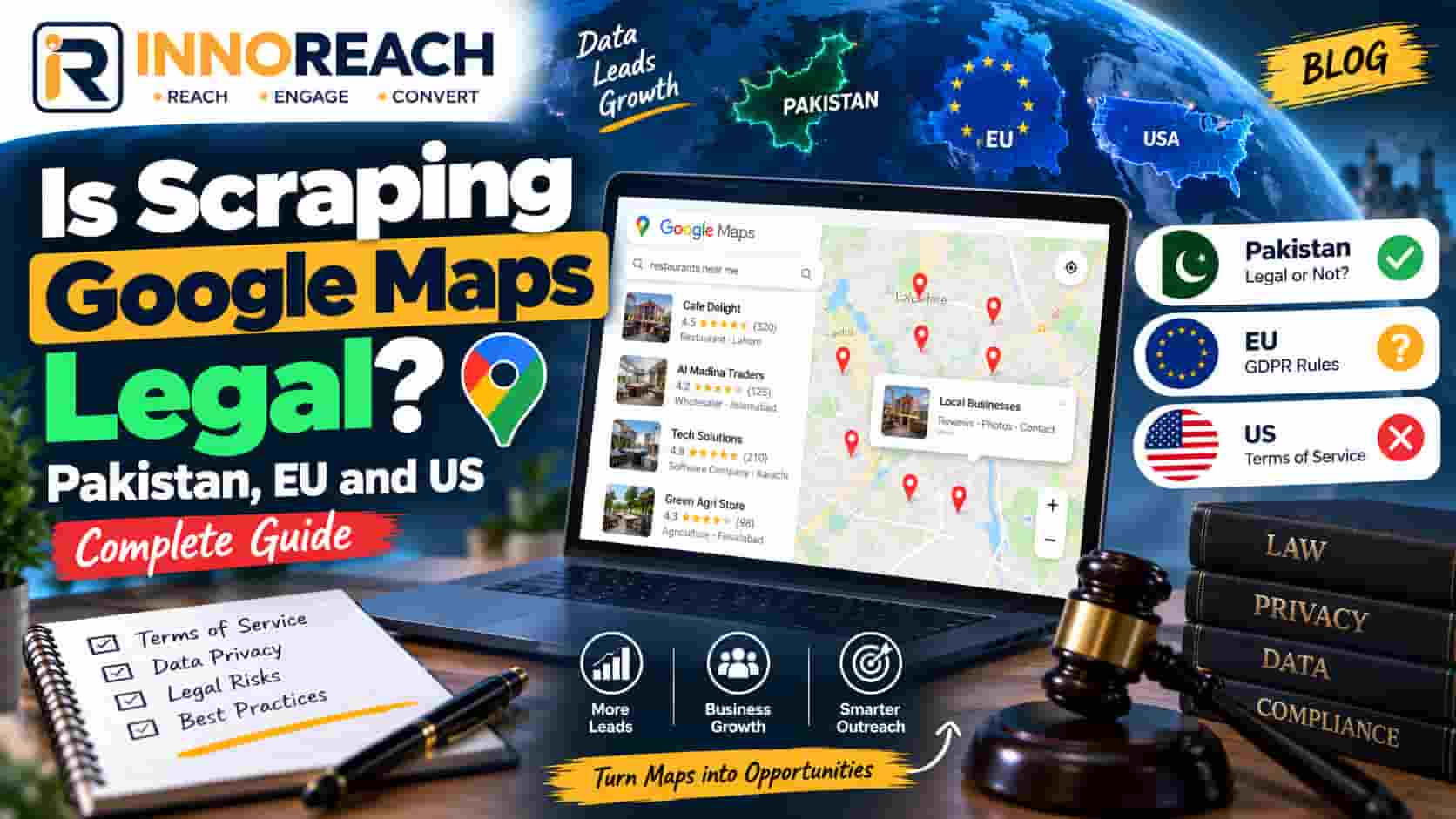
This article is not legal advice. It is a description of how the landscape looks, written by people who sell a lead generation tool, not by lawyers. Laws differ by country, they change, and how any of them applies depends on facts we do not know about your business. For your own situation, consult a qualified lawyer.
With that said — the question deserves a straight answer rather than either the scare stories or the airy reassurance you usually get.
Separate the two questions
Almost every confusing article on this subject fails at the first step, because "is scraping Google Maps legal" is two completely different questions wearing one coat.
Question one: may I collect this information? Someone published a shop's name, phone number and address on a public map. May you write it down, or have software write it down?
Question two: what may I do with it afterwards? Having collected it, may you call the number, message it, email it, add it to a database, sell it?
These have different answers, sit under different bodies of law, and carry very different risk. In our reading, the second question is where nearly all real-world enforcement lives — the rules about unsolicited communication, consent and opt-outs — while the first is more often a matter of contract terms with a platform than of criminal exposure. But that is a general observation, not a conclusion about you.
Reading a page you already loaded
There is a real distinction, worth understanding even if it does not settle anything.
At one end sits a person opening Google Maps, looking at a list of pharmacies, and typing the names into a notebook. Nobody thinks this is unlawful. At the other end sits a script that logs into an authenticated service, defeats a rate limit, and pulls data the operator has deliberately restricted. Those two things are treated very differently by computer-misuse law in most places, and the concept that separates them is usually something like authorisation — did you access a system in a way you were not permitted to?
A browser extension of the kind we make sits close to the first end. It runs inside your own browser, on a results page you loaded yourself, reading what is already rendered on your screen. It does not log into a Google account, and it holds no credentials. Functionally, it is doing the notebook faster.
Two honest caveats. First, "closer to the notebook" is a description of the mechanism, not a legal ruling — the fact that a machine is doing it at scale is something courts in various jurisdictions have taken an interest in, with mixed results. Second, whatever the criminal-law position, Google's own terms of service are a separate matter, they govern the relationship between you and Google, and Google can revise them. If contract risk with a platform matters to your business, that is a question for a lawyer, not for a vendor's blog.
There are more misconceptions in this area than facts; we have pulled the common ones apart in Google Maps scraping myths.
The public business data point
Here is the substantive point about what is actually being collected.
A Google Maps listing exists because a business wanted customers to find it. The shop name, the phone number, the address, the opening hours — every field was published deliberately, for the express purpose of strangers seeing it and getting in touch. That is a different category of information from someone's home address, medical history or personal mobile obtained without their knowledge.
Most data protection regimes recognise a distinction along these lines, though the details vary. Data about a legal entity — a company's registered address, a general enquiries line — is not personal data about an individual in the way a person's own details are. Marketing rules in several regimes also apply differently to business-to-business contact than to consumers.
But there is a genuine grey area, and it deserves naming. A very large share of Pakistani small businesses list the owner's personal mobile as the shop's number. There is no company switchboard at a two-person auto parts trader in Gujranwala; there is Zubair's phone. Under some regimes a sole trader's contact details can be personal data, because they identify an individual, and the B2B carve-outs that apply to company contacts may not extend to them cleanly. Different national implementations treat this differently.
We are not going to pretend that is resolved. What follows from it practically is that the "it's only business data" argument is strong for a registered company's published landline and weaker for an individual trader's mobile, and that you should behave with the same courtesy toward both.
Pakistan
The main instrument is the Prevention of Electronic Crimes Act 2016 (PECA), which includes provisions concerning unsolicited electronic communication, alongside offences around unauthorised access to information systems and various forms of electronic deception. Pakistan also has broader data protection legislation that has been through several drafts and revisions, so the picture here is one that can shift.
Rather than paraphrase statutory language we are not qualified to interpret, the practical reading most Pakistani businesses operate on:
- Say honestly who you are and which company you are calling from.
- Contact businesses about business, in business hours.
- If someone asks you to stop, stop — on every channel, permanently.
- Do not misrepresent yourself to obtain access to anything.
That is also, not coincidentally, how you avoid your number being reported and restricted on WhatsApp, which for most sales teams here is the more immediate consequence than any legal one. For what that looks like in practice, see our WhatsApp outreach guidance.
For anything beyond ordinary outbound sales — building a database as a product, reselling contact data, large-scale automated messaging — take advice from a Pakistani lawyer before you start rather than after.
European Union
If you contact businesses in the EU, GDPR applies to you even though you are outside it, where you are targeting people in the Union.
The concepts that matter most for B2B outreach:
- A lawful basis. GDPR requires one for processing personal data. For B2B marketing, organisations commonly rely on legitimate interest, which requires a documented balancing assessment — your interest against the individual's rights — rather than being a box to tick.
- Transparency. People are entitled to know you hold their data and where it came from. In practice this means a privacy notice and, in some circumstances, telling the person you obtained their details from a public source.
- Rights. Access, erasure, and objection to direct marketing. An objection to direct marketing is absolute — there is no balancing test to lose.
- ePrivacy rules. Separately from GDPR, national implementations of the ePrivacy Directive govern electronic marketing, and consent requirements vary by member state, in some cases differing between corporate and sole-trader recipients.
The honest summary: B2B outreach into the EU is done lawfully by a great many companies, and it involves real paperwork — a documented basis, a privacy notice, a suppression list, and records. If you are doing this at scale, get someone qualified to review your setup. That is not us being cautious for form's sake; the record-keeping obligations are the part people skip and the part that matters if anyone asks.
United States
For commercial email, the reference point is CAN-SPAM. Its requirements are unusually concrete, which makes them easy to comply with:
- No deceptive or misleading header information or subject lines.
- Identify the message as an advertisement, in some manner.
- Include a valid physical postal address.
- Provide a clear, working way to opt out.
- Honour opt-out requests within 10 business days, and do not charge or require anything beyond a simple reply or a single-click page.
CAN-SPAM does not require prior consent for B2B email, which makes the US comparatively permissive on cold email — and penalties for breaching it are significant, so the specific requirements are worth following precisely. Note also that telephone marketing sits under separate rules, and several US states have their own privacy statutes with their own definitions and thresholds. A lawyer familiar with the states you target is the right check.
The three regimes side by side
| Pakistan | EU | US | |
|---|---|---|---|
| Main instrument for outreach | PECA 2016 | GDPR plus national ePrivacy rules | CAN-SPAM, plus state privacy laws |
| Consent needed for B2B contact | Not a general prior-consent regime; unsolicited communication is regulated | Lawful basis required, commonly legitimate interest, documented | Not required for commercial email |
| Opt-out obligation | Stop when asked | Absolute right to object to direct marketing | Honour within 10 business days |
| Records you should keep | Suppression list | Basis assessment, notice, suppression list, source records | Suppression list, address on file |
| Biggest practical risk | Complaints, reported numbers | Missing documentation, ignored objections | Deceptive headers, broken unsubscribe |
Read this as an orientation table, not as compliance guidance. Each cell compresses a body of law into a phrase.
Four rules that keep you clear nearly everywhere
Underneath three different legal systems, the same four behaviours recur. They are not a legal defence, but if you do all four you are doing what the rules are pointing at.
1. Identify yourself honestly. Real name, real company, real reason for the contact. Nothing in any of these regimes is friendly to concealment, and pretending to be someone else is the fastest way to turn a marketing question into a fraud question.
2. Contact businesses about business. A shop's published number, called during business hours, about something relevant to that shop, is a very different act from messaging an individual about something they have no commercial interest in.
3. Keep a record of who asked you to stop. One suppression list, shared across your whole team and every channel, and checked before anyone contacts anyone. This is the single most valuable piece of compliance hygiene a small sales team can have, and it is also just good practice — nothing wastes a rep's morning like calling someone who told your colleague to get lost last month.
4. Actually stop. Immediately, everywhere, permanently. Not "after this campaign".
In InnoReach, a lead marked do-not-contact stays marked for every rep in the organisation, which is the mechanical part of rule three. The judgement part is yours.
What would genuinely be a problem
Because non-alarmist does not mean pretending there is nothing to get wrong. These are the behaviours that move you from ordinary outbound sales into territory where you need advice, and possibly where you should not go at all:
- Impersonation. Claiming to be from Google, from a bank, from a government department, or from a company you are not.
- Ignoring stop requests. The behaviour most likely to produce an actual complaint to an actual regulator.
- Collecting or targeting personal rather than business contacts. Harvesting individuals' details, or contacting a person about something unrelated to the business they published a number for.
- Buying or reselling scraped personal data. Trading in contact data is a materially different business from doing your own outreach, with materially different obligations.
- Circumventing technical restrictions. Defeating access controls, rate limits or authentication is where computer-misuse law becomes genuinely relevant, and it is a long way from reading a page you loaded.
- Volume without context. Bulk unsolicited messaging breaches platform terms independently of any law, and is the thing that gets numbers and domains cut off.
None of that is exotic. It is a list of things a straightforward salesperson would not do anyway.
Where this leaves you
Collecting published business contact details for your own B2B outreach is ordinary commercial practice, done at scale by organisations of every size. The regulated part is generally what you send afterwards, and the rules there are mostly about honesty, relevance and stopping when asked.
Where it stops being simple: contacting people in the EU, where documentation is a real obligation; sole traders whose business number is their personal mobile; and anything involving reselling data or automated bulk messaging.
To repeat what we said at the top: this is not legal advice, and we are not lawyers. If any of the harder cases describes your business — EU targeting, large-scale outreach, data as a product — have a qualified lawyer in the relevant jurisdiction look at your specific setup before you scale it. It is a much cheaper conversation than the alternative.
Our FAQ covers the questions customers ask us most often about this, and our privacy policy sets out how we handle data on our side.
Frequently asked questions
We cannot tell you what is legal in your situation, and nobody writing an article can. What we can describe is the shape of the question: these are business names, phone numbers and addresses the business itself published so customers would find them, and copying published information is treated very differently from accessing a system you are not authorised to use. The regulated part is usually what you send afterwards. Get advice from a qualified lawyer for your own circumstances.
Google's terms address automated access to its services, and different products carry different terms. A browser extension that reads a page you have already loaded in your own browser, without logging into a Google account, sits differently from a script hitting an authenticated API — but "differently" is not the same as "settled", and Google can change its terms whenever it likes. If contract risk with Google matters to your business, that is a question for your lawyer.
A generic company line at a registered company is usually treated as business contact data. A sole trader's personal mobile listed as the shop's number is a genuine grey area, because it can identify an individual. Regulators and national laws differ on where the line falls, which is exactly why a blanket answer from a vendor is not worth relying on.
The Prevention of Electronic Crimes Act 2016 includes provisions dealing with unsolicited electronic communication, alongside offences around unauthorised access and deception. In practice the behaviours it points at are the ones you would avoid anyway: misrepresenting who you are, obtaining access you were not given, and continuing to contact someone who has asked you to stop. For how it applies to your outreach, ask a Pakistani lawyer.
This is where the risk profile changes sharply, and where we would tell you to stop and take advice first. Compiling a list for your own outreach is a different activity from packaging and reselling personal data to third parties, and several regimes treat the second far more strictly. It is also the point at which people move from contacting businesses to trading in contact details.
Ignoring a request to stop. Across every regime we have looked at, and in plain commercial reality, someone who says do not contact me again and is contacted again is the complaint that goes somewhere. Keep a record of opt-outs, honour them across every channel, and most of the rest looks after itself.
Arshad Ali
Innobrains Technologies — we build InnoReach, and we sell with it too.
Keep reading
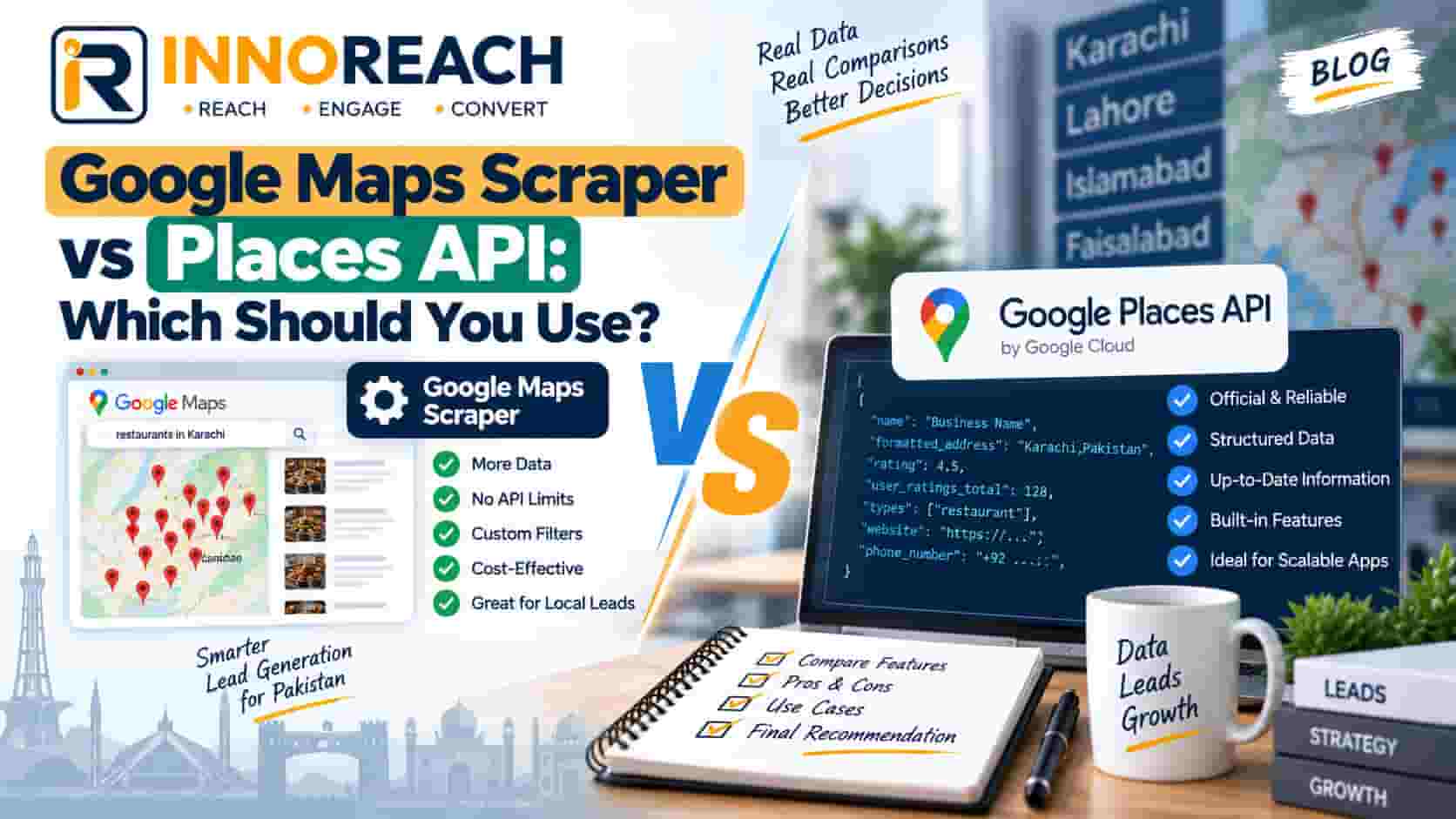
Google Maps Scraper vs Places API: Which Should You Use?
An honest comparison of browser-based Google Maps scraping and Google's official Places API — what each costs, what fields each returns, and which one your situation calls for.
09 Sep 2026 · 11 min
7 Google Maps Scraping Myths That Waste Your Credits
The seven wrong assumptions that burn a trial in an afternoon — what actually happens with emails, result caps, duplicates and the gap between a CSV and a pipeline.
07 Sep 2026 · 7 min
Google Maps Lead Generation: The Complete Guide
How to turn Google Maps into a working list of local business leads — finding them, getting a phone number that dials, calling, and following up until someone says yes or no.
06 Sep 2026 · 16 min